The Vistula Spit canal by the numbers: the lock, the cost, the traffic and the state audit
Poland opened its canal through the Vistula Spit on 17 September 2022, bypassing Russian waters. The numbers: the lock next to Panama's at the same scale, costs from PLN 880 million to 2.16 billion, traffic year by year, the audit findings with the developer's reply, and the state of the fairway to Elbląg in November 2026.
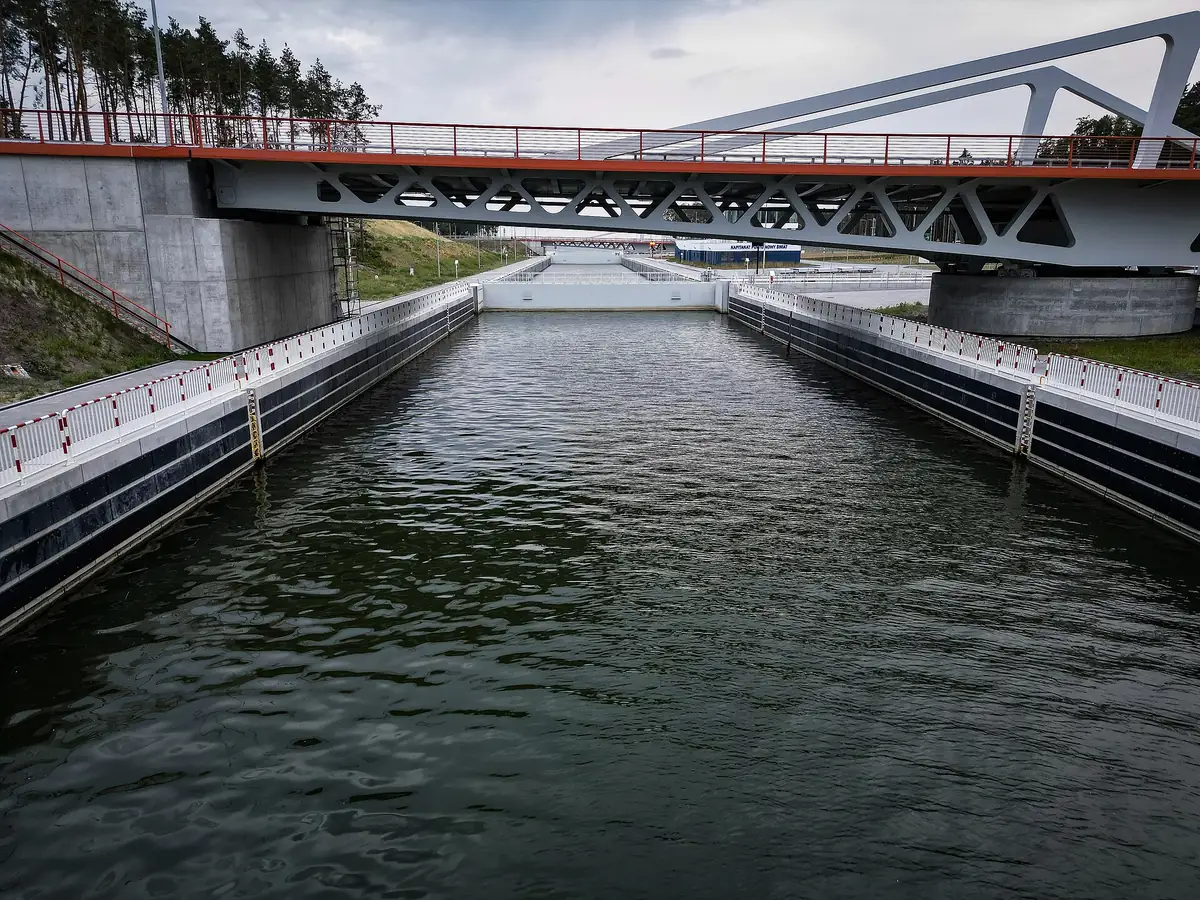
On 17 September 2022 the first vessel passed through the new lock on the Vistula Spit, the narrow sandbar that separates Poland's Vistula Lagoon from the Baltic. Four years on, the canal works, but the port of Elbląg at the end of the waterway still cannot take the ships the whole route was designed for. In the BrikBeam episode (Polish audio), Brik and Bzyk look at the engineering of the cut and the doubts surrounding it. Here we collect the numbers with sources: the lock specifications, the costs, traffic year by year and the state of works in November 2026.
The rule for this article: findings of NIK, Poland's Supreme Audit Office, always come with the reply of the developer, the Maritime Office in Gdynia (UM), and the security argument comes with the caveat that NIK did not assess it. The full list of sources is at the end.
Key numbers at a glance
- 17 Sep 2022: the canal opens; the first vessel through is the "Zodiak II" (Maritime Office in Gdynia; gov.pl, 17 Sep 2022; NIK).
- Lock chamber 200 × 25 m, 6.5 m deep; the whole structure just under 270 m (UM, 3 May 2022 and 16 Sep 2022).
- 4 gates of about 160 t each, moved by cables along rails in the floor (UM, 16 Sep 2022).
- PLN 880 million → PLN 2,160.5 million: the programme's value in 2016 and on the project page in 2025 (NIK, 25 Sep 2023; UM, 12 Jun 2025).
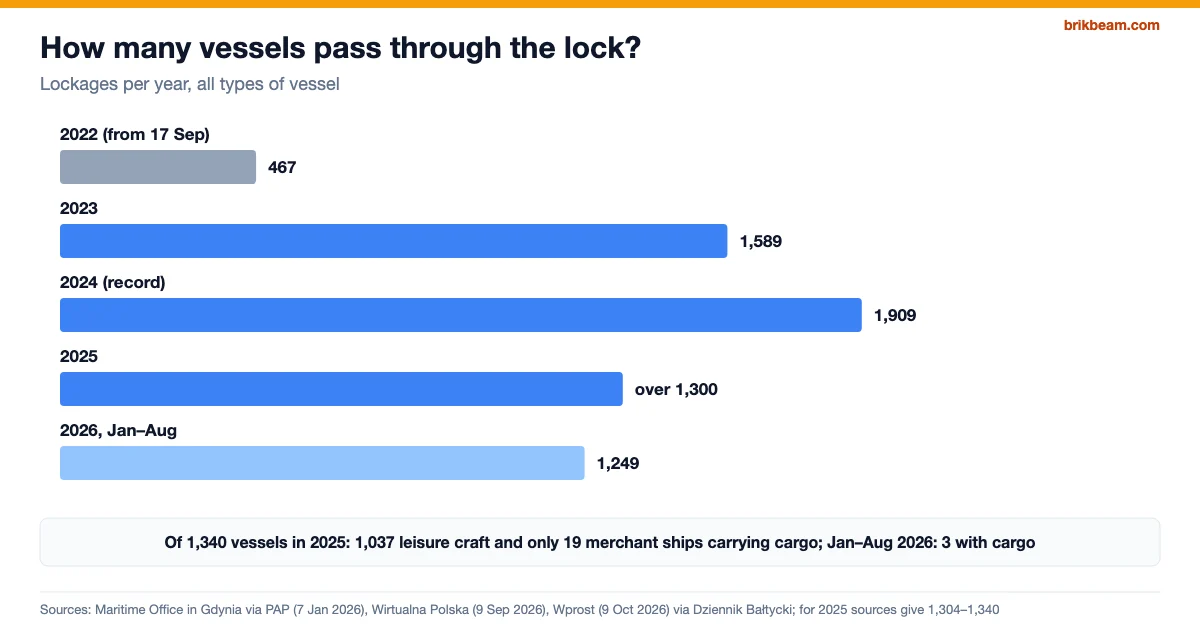
- 1,909 vessels through the lock in the record year 2024, yet in 2025 only 19 merchant ships carrying cargo (UM via PAP, 7 Jan 2026; WP, 9 Sep 2026).
▶ From our YouTube channel
Przekop Mierzei za ponad 2 mld zł. Czy to w ogóle działa?Brik and Bzyk do the maths on megastructures — an episode about the Vistula Spit canal. Audio in Polish. Watch on YouTube ↗
Why the canal: the geography in one paragraph
The Vistula Lagoon has one natural link to the Baltic: the Strait of Baltiysk (Pillau) in Russia's Kaliningrad region. Ships from Elbląg therefore had to pass through Russian waters and needed Russia's permission. The canal avoids that (AP, 17 Sep 2022; Maritime Office, 16 Sep 2022). By our measurement on OpenStreetMap, Elbląg is about 21 km in a straight line from the new lock and about 62 km from Baltiysk. The Polish government called the cut a strategic investment; the special act of 24 Feb 2017 refers to an important state security interest (UM; NIK, list of legal acts).
Engineering: the lock, gates, breakwaters and an island
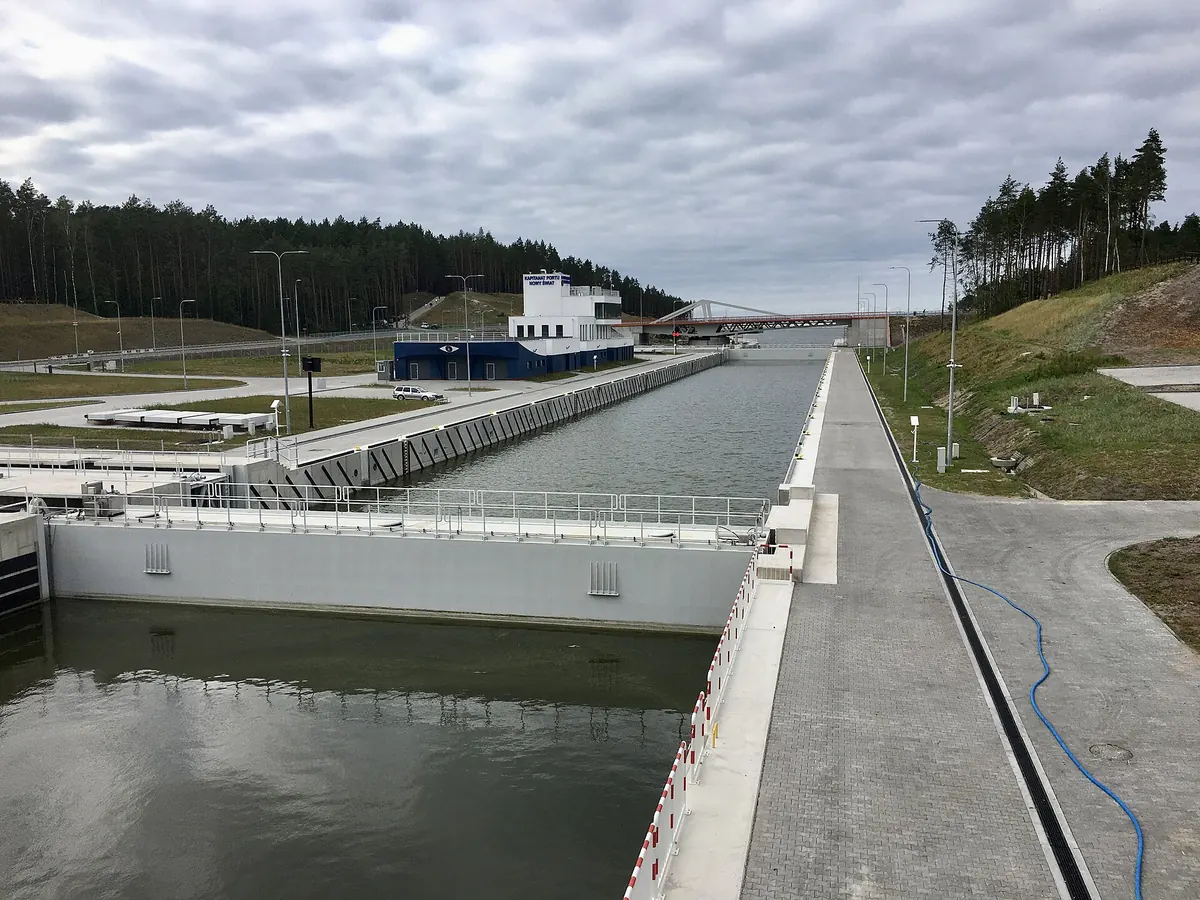
The canal itself is about 1,300 m long, up to 120 m wide and 5 m deep. Among other things, 800,000 m³ of material were excavated (UM, 16 Sep 2022; Notes from Poland, 17 Sep 2022). The lock keeps the waters of the Gulf of Gdańsk and the lagoon from mixing and stops the difference in levels from endangering vessels (UM, 3 May 2022).
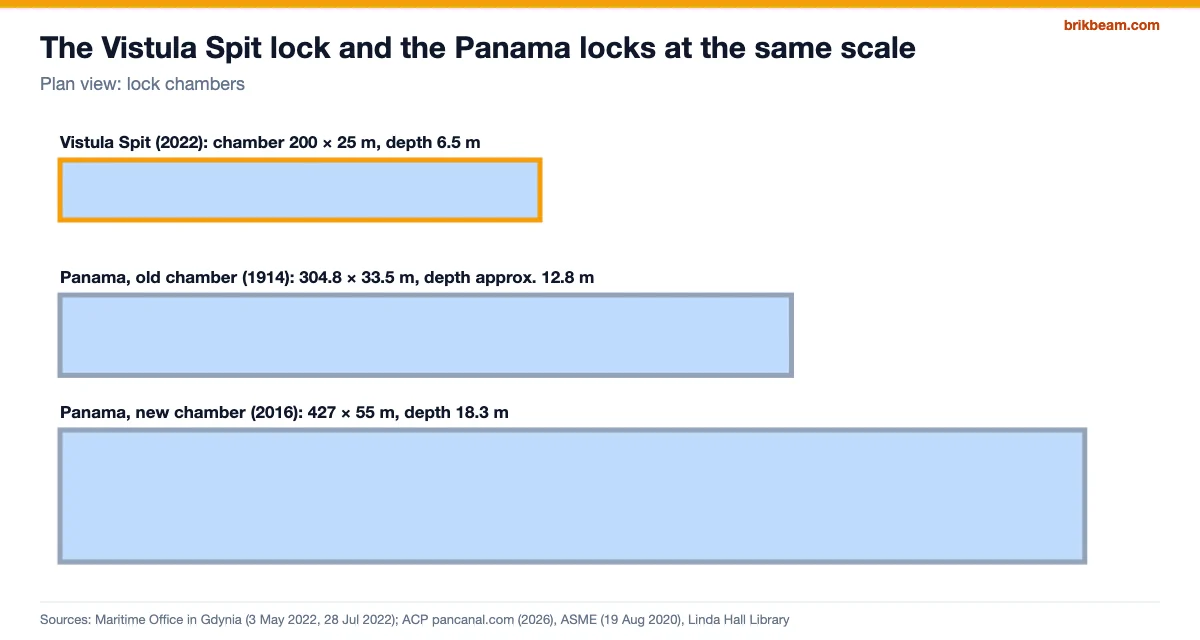
Key construction numbers (UM, 16 Sep 2022 and 3 May 2022):
| Element | Specification |
|---|---|
| Lock gates | 4 gates of 6 segments, about 160 t each, heaviest part about 33 t; moved by cables on rails in the floor, duplicated in case one fails |
| Swing bridges | 2 bridges on the road to Krynica Morska, each over 60 m, structure with counterweight about 550–560 t |
| Breakwaters | eastern over 1,000 m, western over 500 m, 400,000 t of rock armour |
| X-block units | almost 10,000 precast units of 2.5–12 t, each numbered and placed by coordinates |
| Artificial island (Estyjska Island) | about 180 ha, an ellipse of about 1,906 × 1,166 m, about 4.5 km from the canal, ringed with sheet piling and rock |
According to the Maritime Office, x-block plus units were laid under water here for the first time anywhere, with divers. That is the developer's claim, which we have not verified elsewhere. The first stage took 35 months, on schedule (contract with NDI/Besix of 4 Oct 2019 for PLN 991.6 million) (UM, 16 Sep 2022; NIK).

What it cost: from PLN 880 million to PLN 2.16 billion
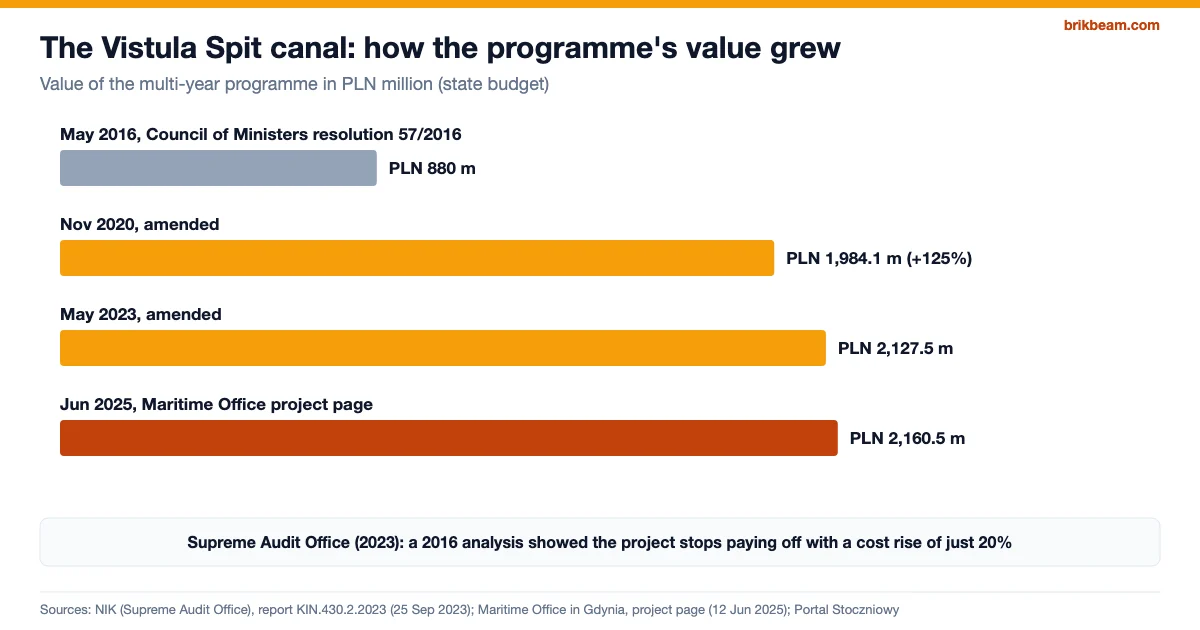
The multi-year programme was set up by a Council of Ministers resolution of 24 May 2016 at PLN 880 million. A resolution of 24 Nov 2020 raised it to PLN 1,984.1 million (+125%), and in May 2023 to PLN 2,127.5 million (NIK, pp. 6 and 8). The Maritime Office's project page now gives PLN 2,160,499.1 thousand (UM, 12 Jun 2025; Portal Stoczniowy). It is not clear whether that covers every later dredging contract, so for the total cost we say "over PLN 2.1 billion".
Myth: "The canal cost PLN 880 million." That was the 2016 estimate, before the scope grew.
What NIK found and how the Maritime Office replied
In its findings of 25 Sep 2023 (KIN.430.2.2023), NIK concluded that "as a result, the Investment lost its economic justification". According to a 2016 analysis commissioned by the Maritime Office's director, the project stopped paying off with a cost rise of just 20%. NIK also pointed to PLN 213.4 million spent in breach of regulations and commitments exceeding the budget by PLN 157.7 million (NIK, 25 Sep 2023).
The Maritime Office replied that costs rose because the scope grew (the artificial island, swing bridges instead of lift bridges, a new bridge in Nowakowo, 2.5 km of riverbank protection on the Elbląg river, among others) and because prices rose; as an example it cited the minimum wage of PLN 1,680 in 2014 against PLN 3,600 gross in 2023. The irregularities identified by NIK are described by the Office as "shortcomings" with no negative effect on the State Treasury's interest (UM, 9 Nov 2023).
An important caveat: NIK states that whether the project was justified on state security grounds was not part of the audit (NIK, p. 7). The economic assessment and the strategic argument are two separate questions.
Traffic: who uses the canal

Quite a few vessels use the canal: the record year 2024 saw 1,909 lockages. The mix of traffic says more. In 2025, of 1,340 vessels, 1,037 were leisure craft, 187 state vessels, 90 merchant ships without cargo and 19 merchant ships carrying cargo (Maritime Office spokesperson via PAP, 7 Jan 2026). From January to August 2026: 1,249 vessels, including 1,024 leisure craft, 106 barges working on the fairway and 3 merchant ships with cargo (Wprost, 9 Oct 2026; WP, 9 Sep 2026). For 2025, sources give between 1,304 and 1,340 vessels.
Two myths at once: "Nobody uses the canal" is false (over a thousand vessels a year), but "the canal carries a lot of cargo" is not true either (a dozen or so cargo ships a year).
Why ships still do not reach Elbląg
The whole waterway from the gulf to Elbląg is almost 23 km: the lock with its outer harbour, over 10 km of fairway across the lagoon and over 10 km along the Elbląg river (UM via WP, 9 Sep 2026). The canal is only the start of it. The state of works in November 2026:
| Stage | Scope | Status | Sources |
|---|---|---|---|
| I | canal, lock, harbour | completed 2022 | UM; NIK |
| III | fairway across the lagoon | handed over 22 May 2023 | UM (project page) |
| II | riverbank protection, Nowakowo bridge | handed over 27 Mar 2024 | UM |
| IV | dredging the Elbląg river | contract 15 Jul 2026, PLN 51.4 million, about half done; completion announced for the turn of 2026/2027 | UM 15 Jul 2026; Rynek Infrastruktury 12 Jun 2026 |
| V | about 3 km to the port (P1–Port), turning basin Ø 160 m | tender announced 23 Oct 2026, bids due 25 Nov 2026, 24 months to build | Rynek Infrastruktury 23 Oct 2026; UM |
In the original plan the fairway ended about 1 km short of the port; that stretch was added to the programme only in 2024. Sediments on the last kilometre exceed the limits for PAHs (polycyclic aromatic hydrocarbons), so the contaminated material has to be removed before dredging (UM, 20 Oct 2025 and 22 Mar 2024). In addition, the city of Elbląg is due to rebuild the port quays with EU funds (Rynek Infrastruktury, 12 Jun 2026).
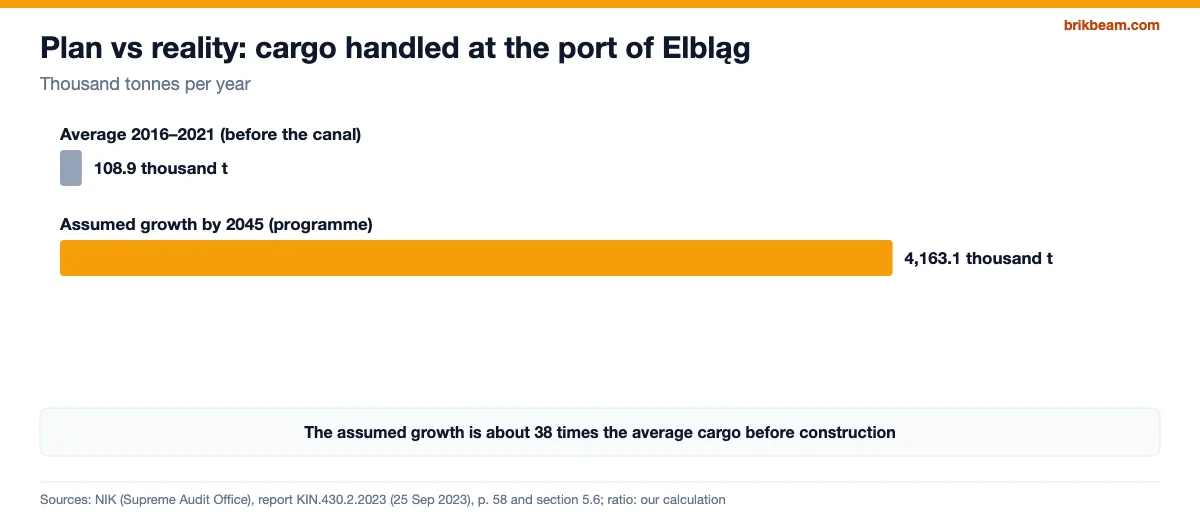
The programme assumed that by 2045 cargo handled at Elbląg would grow by 4,163.1 thousand t a year. The 2016–2021 average was 108.9 thousand t a year (NIK, p. 58). The design vessel is up to 100 m long, 20 m wide and 4.5 m in draught; according to NIK, such ships will not reach the port until the port itself is upgraded (NIK; UM, 28 Jul 2022). In June 2026, Deputy Infrastructure Minister Arkadiusz Marchewka told the Polish parliament the project was like "building a motorway that ends in a forest" (Rynek Infrastruktury, 12 Jun 2026).

Environment
About 10,000 trees were felled for the project on 15–20 Feb 2019 (Forsal/PAP, 20 Feb 2019). The European Commission then called for the works to stop until the environmental decision had been checked against EU law, and environmental groups pointed to damage to two Natura 2000 sites (Forsal; RMF24; OKO.press, 2019). The Maritime Office says that thanks to the lock the waters do not mix, so the project does not affect the lagoon's salinity, and that the artificial island has become a habitat for birds (UM, 3 May 2022; UM via WP, 9 Sep 2026).
What builders and investors can take from it
- A concept-stage estimate is not a budget. The programme grew by 125% in four years, mostly through scope that was not there at the start. On any project, check which items (access roads, spoil disposal, utility connections) are in the estimate and which are still to come.
- Infrastructure works as a whole. A lock finished on time delivers nothing until the fairway and quays exist. In housing, that is a house without a utility connection: the building stands but does not work.
- Know the break-even point before you start. The 2016 analysis showed that a 20% cost rise was enough for the project to stop making economic sense. Work out that threshold for every build; the labour rate calculator and the concrete calculator help estimate how price changes feed through to cost.
The episode and Shorts
The full episode is embedded above (Polish audio). Shorts (Polish): 160 t gates with no hinges?, Over PLN 2 billion. And the cargo ships?, Numbered blocks under water?, The audit office on lost justification.
Other episodes with articles: Megaprojects: all BrikBeam episodes. A full-scale canal for comparison: the Panama Canal by the numbers.
▶ Subscribe to BrikBeam on YouTube: big builds worked out so you can check the maths.
Sources
- Maritime Office in Gdynia, "Budowa drogi łączącej Zalew Wiślany z Zatoką Gdańską", project page (modified 12 Jun 2025).
- Maritime Office in Gdynia, "Spektakularna budowa zakończona…", 16 Sep 2022.
- Maritime Office in Gdynia, "Śluza kanału przekopu Mierzei Wiślanej już po testach!", 3 May 2022; release of 28 Jul 2022.
- Maritime Office in Gdynia, reply to the NIK findings, 9 Nov 2023; releases of 22 Mar 2024, 20 Oct 2025 and 15 Jul 2026.
- NIK (Supreme Audit Office), post-audit findings KIN.430.2.2023, 25 Sep 2023.
- gov.pl (Ministry of Infrastructure), canal opening, 17 Sep 2022.
- AP, 17 Sep 2022; Notes from Poland, 17 Sep 2022; PAP, 17 Sep 2022.
- PAP, lock traffic in 2025, 7 Jan 2026; Wirtualna Polska, 9 Sep 2026; Wprost, 9 Oct 2026 (via Dziennik Bałtycki).
- Rynek Infrastruktury, 12 Jun 2026 and 23 Oct 2026.
- Portal Stoczniowy (programme value).
- Forsal/PAP, 20 Feb 2019; RMF24; OKO.press (2019): tree felling and the European Commission's position.
- OpenStreetMap (straight-line distances, our measurement).
By the BrikBeam editorial team, 22 Nov 2026. State of works as of 22 Nov 2026; dates for later stages are the developer's announcements. Spotted a mistake? Tell us via the contact form.
Pobierz kompletny pakiet wzorów umów i protokołów budowlanych
Zyskaj natychmiastowy dostęp do prawnie sprawdzonych szablonów: Umowa o roboty budowlane, Umowa z podwykonawcą, Plan BIOZ, Protokół odbioru końcowego, Karta gwarancyjna i Harmonogram. Gotowe do edycji w Word i Excel.