How much does the snow on a roof weigh? Snow zones, roof pitch and a worked Eurocode example
7.3 tonnes per 100 m²: that is what Eurocode assumes for snow on an ordinary roof in central Poland. Where the number comes from, how the zone and the pitch change it, why 18 cm of wet snow weighs as much as 72 cm of powder, and what the law asks of owners.
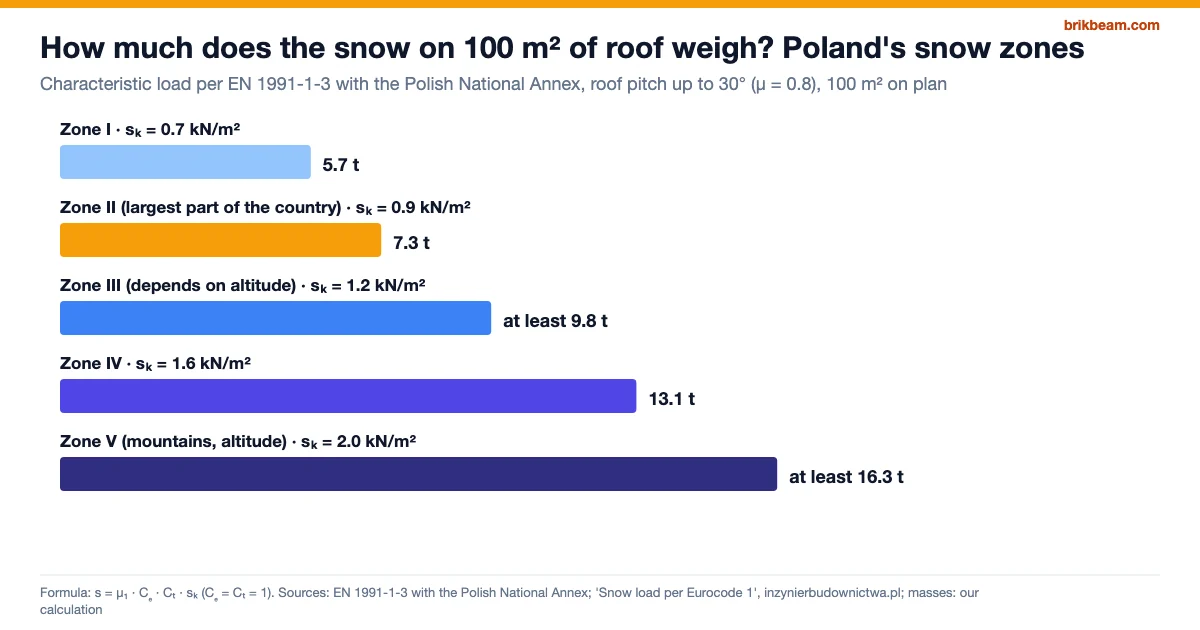
Snow on a roof looks harmless, but it has a weight and that weight can be calculated. Under the Eurocode for snow loads, EN 1991-1-3 with the Polish National Annex, 100 m² of an ordinary roof in zone II, which covers most of Poland, has to be designed for about 7.3 tonnes of snow. In the mountains, the same house must carry more than twice that. In the BrikBeam episode "How much snow can your roof hold?" Brik and Bzyk show it on a single house. Here we write the calculation out so you can repeat it for your own roof.
Two notes before we start. This is educational material: the capacity of a specific roof structure is for a structural engineer to assess. And the numbers below use the Polish National Annex; other countries set their own ground snow loads (Australia and New Zealand, for example, use AS/NZS 1170.3), but the method is very similar.
Key numbers at a glance
- Zone II: 0.9 kN/m² ground snow load (about 92 kg/m²), the largest zone in Poland (EN 1991-1-3, Polish National Annex; inzynierbudownictwa.pl).
- 100 m² on plan, roof pitch up to 30°, zone II: about 7.3 t of snow (our calculation following the standard).
- From 60° pitch the standard assumes no snow on the roof, because it slides off (EN 1991-1-3, Table 5.2).
- 18 cm of wet snow weighs as much as 72 cm of fresh powder (EN 1991-1-3, Annex E).
- Buildings with a footprint over 2,000 m² must be inspected twice a year in Poland, by 31 May and by 30 November (Polish Construction Law, art. 62; GUNB).
▶ From our YouTube channel
Ile śniegu udźwignie twój dach? 7 ton na 100 m²Brik and Bzyk do the maths on megastructures — an episode about how much snow a roof can carry. Original audio in Polish; other audio tracks are available in the player settings. Watch on YouTube ↗
How the standard works out snow on a roof
The roof snow load is s = μ₁ · Cₑ · Cₜ · sₖ, where:
- sₖ is the characteristic ground snow load for the zone, in kN/m² (1 kN/m² ≈ 102 kg/m²),
- μ₁ is the roof shape coefficient, which depends on the pitch,
- Cₑ (exposure) and Cₜ (thermal) are 1 in typical situations.
The result applies to each square metre of the roof's horizontal projection (plan area), not to the sloping roof surface. That is a common mistake in back-of-the-envelope estimates.
| Zone | sₖ [kN/m²] | Roof up to 30°, 100 m² on plan | Notes |
|---|---|---|---|
| I | 0.7 | about 5.7 t | western Poland |
| II | 0.9 | about 7.3 t | largest area of Poland |
| III | 0.006·A − 0.6, at least 1.2 | at least 9.8 t | A = altitude in metres |
| IV | 1.6 | about 13.1 t | north-east |
| V | 0.93·e^(0.00134·A), at least 2.0 | at least 16.3 t | mountains |
Sources: EN 1991-1-3 with the Polish National Annex; inzynierbudownictwa.pl, "Snow load according to Eurocode 1"; masses: our calculation (sₖ × 0.8 × 100 m² ÷ 9.81).

In zones III and V the value grows with altitude. Example: a house in zone III at 500 m above sea level has sₖ = 0.006 × 500 − 0.6 = 2.4 kN/m², twice the zone minimum. You can check a value in the roof snow load calculator.
Roof pitch: the steeper the roof, the less snow
For mono- and duopitch roofs, μ₁ is 0.8 up to a 30° pitch, then falls linearly (μ₁ = 0.8 · (60 − α)/30) and is zero from 60° (EN 1991-1-3, Table 5.2; inzynierbudownictwa.pl).
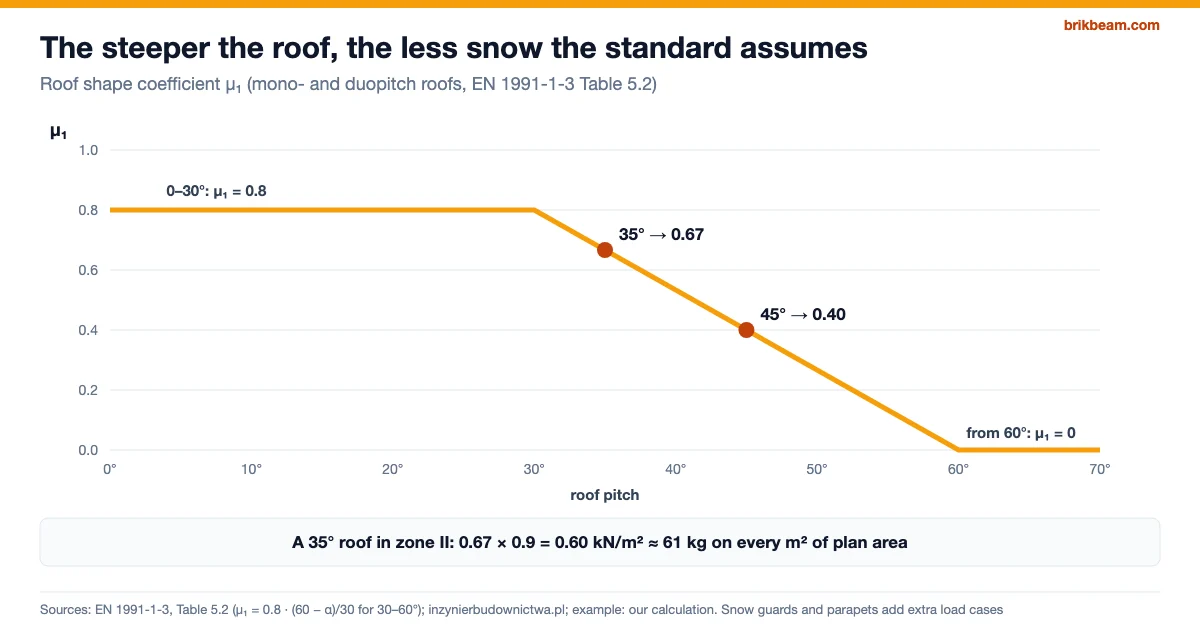
Example: a 35° roof in zone II: 0.667 × 0.9 = 0.60 kN/m², about 61 kg on every square metre of plan area. The standard also covers extra load cases: drifts against parapets and the walls of a taller part of the building, valleys, and snow held back by snow guards. Locally, the load there can be much higher than in this table.
Depth says little; weight is what counts
The same 0.72 kN/m² (zone II, roof up to 30°) gives very different depths, because snow varies in bulk weight density: fresh about 1.0 kN/m³, settled 2.0, old 2.5 to 3.5 and wet 4.0 kN/m³ (EN 1991-1-3, Annex E; inzynierbudownictwa.pl "How much does snow weigh?").
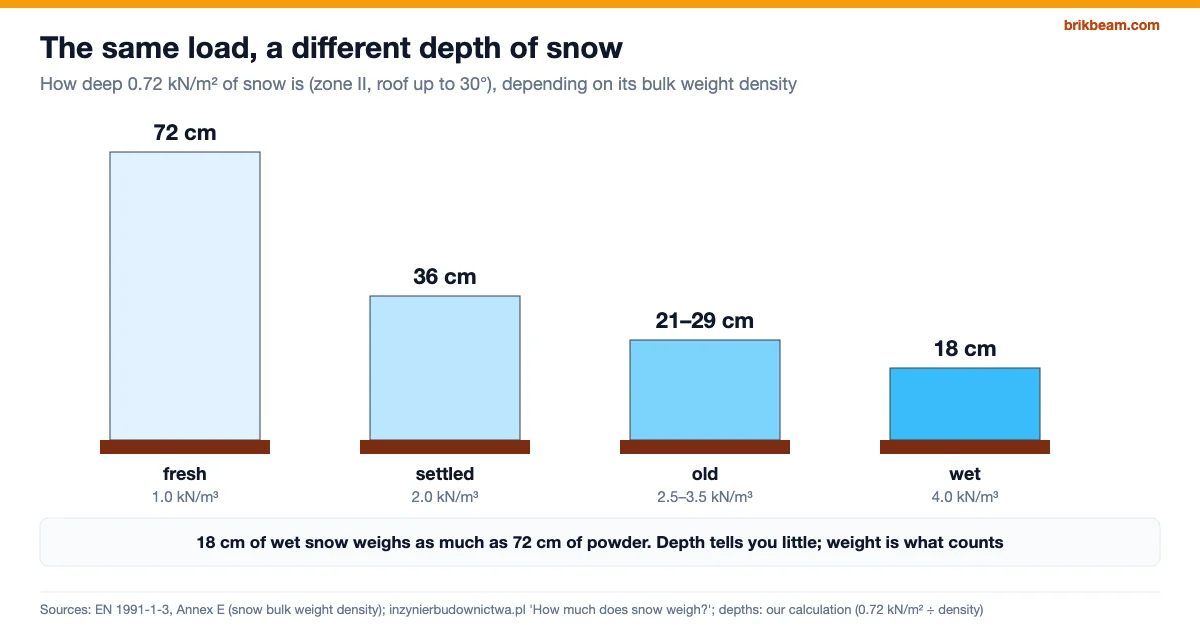
The practical lesson: 20 cm of wet, compacted snow after a thaw and a frost can be more dangerous than half a metre of powder just after a snowfall. To judge the risk, weigh a sample (for example a 10 × 10 cm column) rather than measuring depth alone.
Worked example: an 8 × 12 m house, 35° roof, zone II
We used the default settings of the BrikBeam roof framing calculator: an 8 × 12 m building, 35° gable roof, 60 cm eaves. The calculator gives 148.3 m² of roof surface and 3.62 m³ of C24 timber including a 10% margin, about 1.66 t (read on 5 Nov 2026).
| Step | Calculation | Result |
|---|---|---|
| 1. Plan area | 148.3 m² × cos 35° | about 121.5 m² |
| 2. Load per m² on plan | 0.667 × 0.9 kN/m² | 0.60 kN/m² |
| 3. Whole roof | 121.5 m² × 0.60 kN/m² ÷ 9.81 | about 7.4 t of snow |
| 4. Compared with the timber | 7.4 t ÷ 1.66 t | snow about 4.5 times heavier than the timber |
Then there is the roof covering. Clay tiles weigh about 45 to 50 kg/m², so 148 m² of roof carries about 7 t of tiles, almost as much as the design snow. Steel tile sheet is about 5 kg/m², less than 1 t in total (budujemydom.pl; muratordom.pl). That is why swapping metal sheeting for clay tiles without checking the roof structure is risky: you add a permanent load comparable to the whole design snow load.

Chorzów 2006: why the rules changed
On 28 January 2006, at about 5:15 pm, the roof of a hall at the Katowice International Fair in Chorzów, Poland, collapsed during a racing pigeon show. 65 people died. The roof covered about one hectare (Wikipedia, "Katowice Trade Hall roof collapse"; RMF24; PAP). According to the inquiry and court experts, the causes were errors in the detailed design, an earlier repair carried out without calculations or supervision, and accumulated snow that had not been cleared and had turned to ice from below (Wikipedia; RMF24; Gość Katowicki). It is the worst construction disaster in Poland's history (RMF24; PAP).
After the disaster, Poland introduced twice-yearly inspections of large structures. Today the rule is in art. 62(1)(3) of the Construction Law:
- buildings with a footprint over 2,000 m² and other structures with a roof area over 1,000 m² must be inspected at least twice a year, by 31 May and by 30 November,
- the inspection must be done by a person with the relevant building qualifications,
- skipping it is a petty offence punishable by a fine (GUNB, "Technical condition inspections"; inzynierbudownictwa.pl; prawo.pl).
Note: according to GUNB and legal commentary, the 1,000 m² roof criterion applies to structures that are not buildings. A building with a footprint of up to 2,000 m² is not covered just because it has a large roof. Separately, art. 61 requires every owner or manager to keep a structure safe to use during heavy snowfall, including a single-family house.
When to act: practical tips
- Look at weight, not centimetres. After a thaw and a frost, the same layer weighs several times more.
- Watch the places where snow collects: valleys, areas next to parapets, walls and chimneys, and lower roofs next to a taller block.
- Clear the roof evenly. Taking snow off only one side creates an unbalanced load.
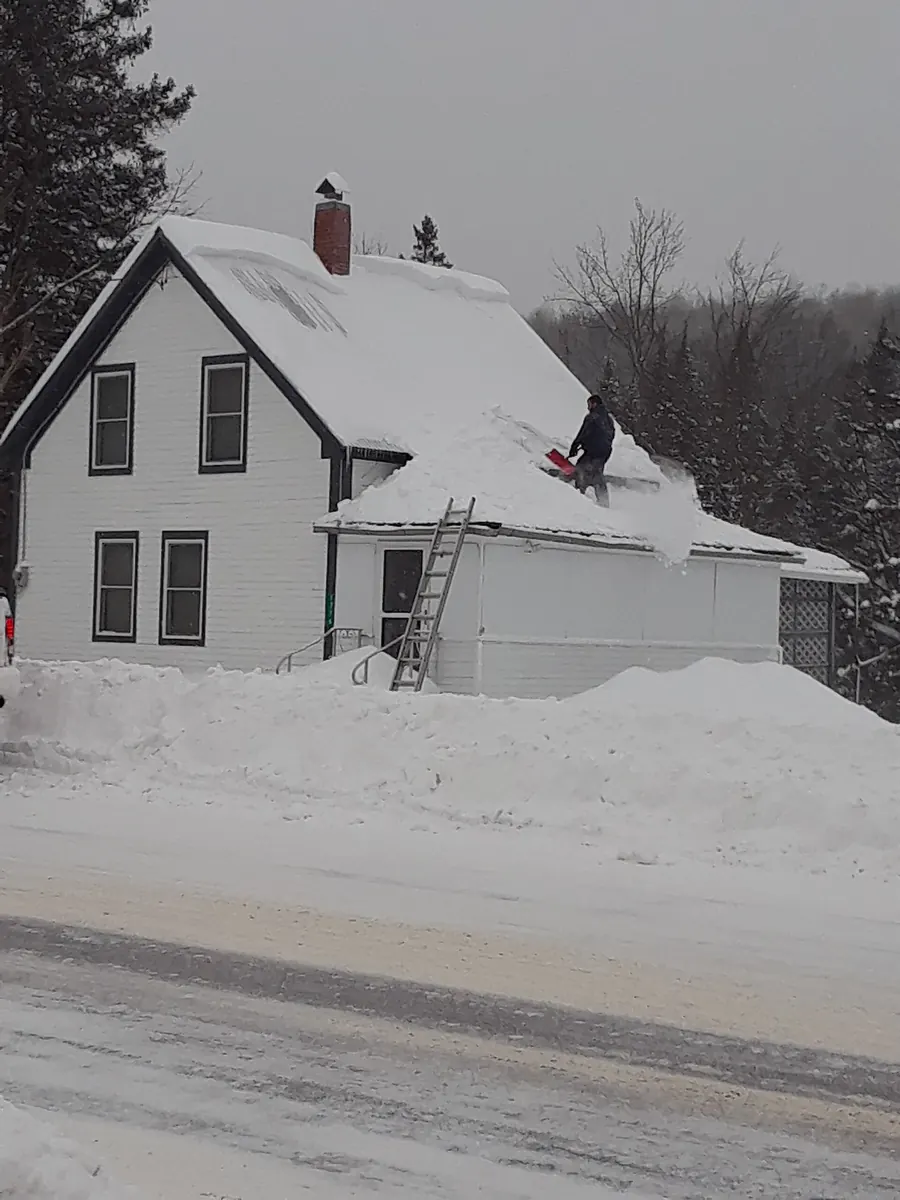
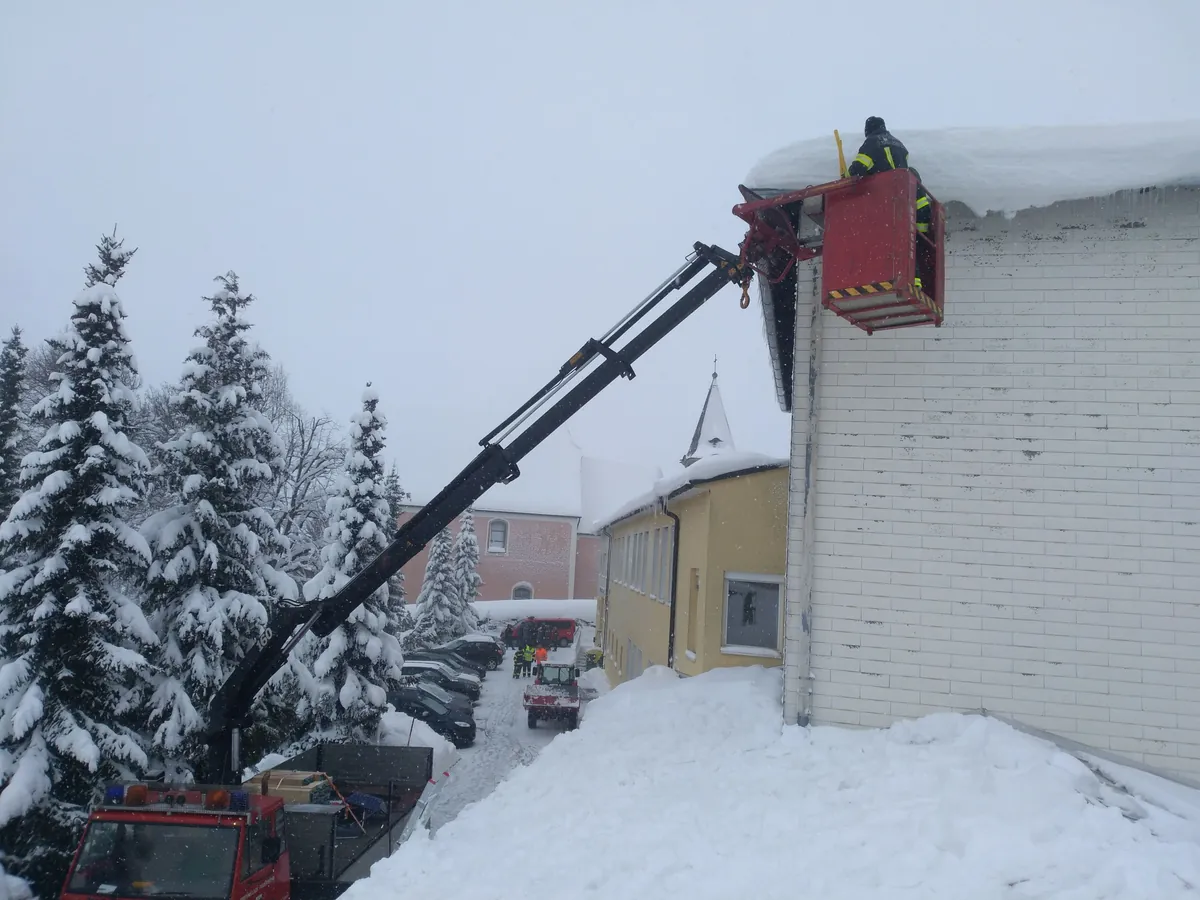
- People matter more than the roof. Working on a roof needs fall protection; for large buildings it is better to hire a firm with a cherry picker.
- Warning signs (sagging, cracking sounds, new cracks in plaster, doors sticking under the ceiling) mean leave the building and call a professional, not climb onto the roof.
Myths at a glance
- "30 cm of snow is always the same load": no, wet snow weighs up to four times as much as fresh snow.
- "A flat roof is the safest": the standard gives it the highest coefficient (0.8), and meltwater stays where it is.
- "The standard covers snow on a steep roof": from 60° μ₁ = 0, so safety depends on how the snow slides off and on snow guards, which bring their own loads.
- "If the roof survived 20 winters, it will survive any": a new covering, extra insulation or a taller extension change the loads, and timber can lose capacity over time through damp and pests.
The episode and Shorts on this topic
The full episode is embedded above (Polish audio, with additional audio tracks in the player settings). Short versions:
- How much does the snow on your roof weigh?
- 18 cm of wet snow = 72 cm of powder
- At 60°, the standard assumes zero snow on the roof
- Snow weighs 4× more than the roof truss? Let's count
- The same house, but 16 tonnes of snow on the roof in the mountains
More megaprojects and articles in the series: Megaprojects: all BrikBeam episodes. Work out your own roof: snow load calculator and roof framing calculator.
▶ Subscribe to BrikBeam on YouTube: construction worked out so you can check the maths.
Sources
- EN 1991-1-3 Eurocode 1: Actions on structures, Part 1-3: Snow loads, with the Polish National Annex (zones, Table 5.2, Annex E).
- inzynierbudownictwa.pl, "Snow load according to Eurocode 1", "How much does snow weigh?" and "Clearing snow from buildings: regulations".
- Polish Construction Law, art. 61 and art. 62(1)(3) (consolidated text, as of Nov 2026); GUNB (General Office of Building Control), "Technical condition inspections", gov.pl.
- inzynierbudownictwa.pl, "Periodic technical inspections of buildings"; prawo.pl, "Inspection of a building with a roof area over 1,000 m²".
- Wikipedia, "Katowice Trade Hall roof collapse" (inquiry report of 31 Mar 2006); RMF24, 20th anniversary report (2026); PAP; Gość Katowicki, "10 years after the disaster".
- budujemydom.pl; muratordom.pl: weights of roof coverings.
- BrikBeam roof framing calculator, read on 5 Nov 2026 (default settings).
By the BrikBeam editorial team, 22 Nov 2026. This article is educational and does not replace structural calculations or an inspection by a qualified person. Spotted a mistake? Tell us via the contact form.
Pobierz kompletny pakiet wzorów umów i protokołów budowlanych
Zyskaj natychmiastowy dostęp do prawnie sprawdzonych szablonów: Umowa o roboty budowlane, Umowa z podwykonawcą, Plan BIOZ, Protokół odbioru końcowego, Karta gwarancyjna i Harmonogram. Gotowe do edycji w Word i Excel.