The Golden Gate by the numbers: a safety net, a cable of 27,572 wires and a colour that was never in the plan
While the Golden Gate was being built, a net strung under the deck saved 19 men. The bridge in numbers: a span record that stood for 27 years, a cable of 27,572 wires, USD 35 million of bonds in the Depression, a colour taken from the primer and painting that never really ends.
The Golden Gate is more than a San Francisco postcard. It is the bridge where worker safety was first taken seriously at this scale: a net strung under the deck saved 19 men. It is also a case study in financing a project in the depths of the Great Depression, and in a colour that came from an anti-corrosion primer. In the BrikBeam episode (Polish audio), Brik and Bzyk tell the story of the "Half-Way-to-Hell Club". Here we collect the numbers with sources.
The facts come from the episode's fact sheet (checked on 6 Nov 2026): above all the bridge operator's site (Golden Gate Bridge, Highway and Transportation District, goldengate.org) and the FHWA / Library of Congress fact sheet. The full list is at the end.
Key numbers at a glance
- 1,280 m main span, the world's longest from 1937 to 1964, i.e. for 27 years (goldengate.org; FHWA).
- 227 m towers above the water (goldengate.org; FHWA).
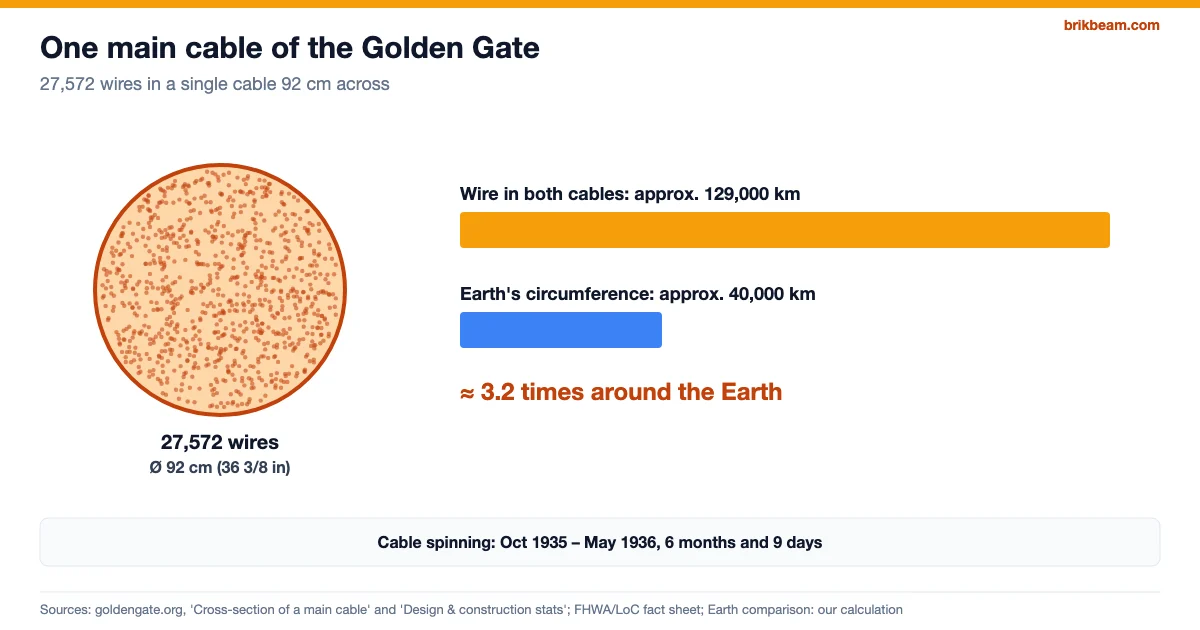
- 27,572 wires in a single cable 92 cm across; about 129,000 km of wire in both cables (goldengate.org).
- 19 workers caught by the net, the "Half-Way-to-Hell Club"; 11 deaths during construction (FHWA; goldengate.org).
- USD 35 million in bonds, approved in 1930 by about 3 to 1 (goldengate.org; FHWA).
▶ From our YouTube channel
Klub w połowie drogi do piekła: 19 ludzi i jedna siećBrik and Bzyk do the maths on megastructures — an episode about building and painting the Golden Gate Bridge. Audio in Polish. Watch on YouTube ↗
The net, hard hats and the "Half-Way-to-Hell Club"
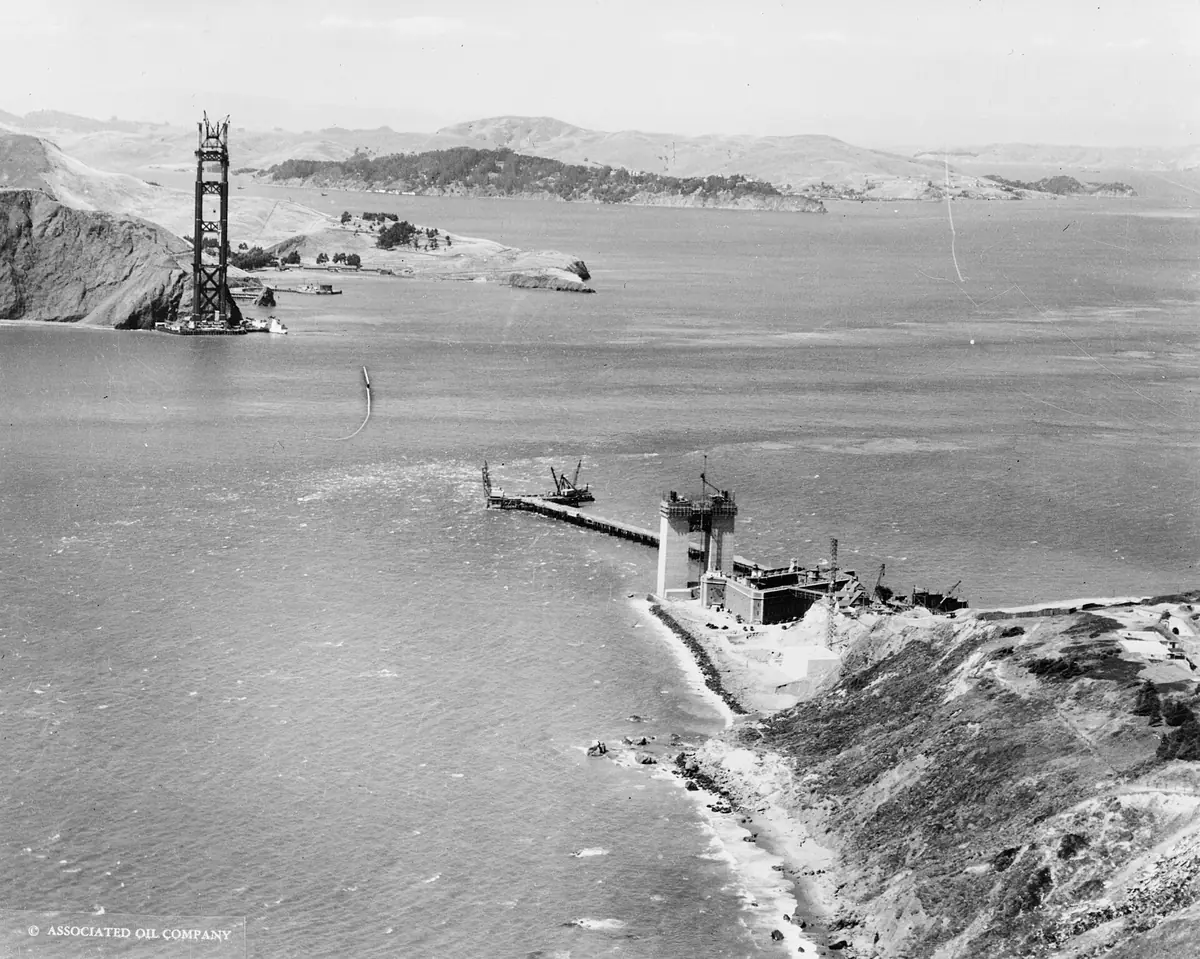
A safety net was strung under the deck from one end of the bridge to the other. It caught 19 workers, who called themselves the "Half-Way-to-Hell Club" (FHWA/LoC; goldengate.org "All in a Day's Work"). The project also introduced hard hats, then a first in bridge building, plus goggles, wind cream and a special diet against dizziness (FHWA; goldengate.org).
Until February 1937 only one man had died on the job. On 17 Feb 1937 a moving scaffold used to strip formwork from under the deck broke away and tore through the net; 10 men died and two survived the fall into the water (FHWA; goldengate.org; Britannica). In total, construction cost 11 lives. The deck is about 67 m (220 ft) above the water (goldengate.org).
Compared with a site today: nets and hard hats are now standard at any height, but in the 1930s they were the exception. The principle has not changed: collective protection (a net, a guard rail) still works when someone forgets their personal protection.
A cable of 27,572 wires

Each of the two main cables is 92 cm across and made of 27,572 individual wires. The wire in both cables adds up to about 129,000 km (80,000 miles), about 3.2 times the Earth's circumference (goldengate.org; Earth's circumference about 40,075 km). The cables were "spun" on site from October 1935 to May 1936, in 6 months and 9 days (goldengate.org).
For the bridge's 50th birthday on 24 May 1987, organisers expected 50,000 people; about 800,000 came, and about 300,000 got onto the deck. The deck sagged by 2–3 m (7–10 ft), its arch flattened, and according to Caltrans engineer Charles Seim the cables were working at about 40% of their yield point at maximum design load (FHWA/LoC). The bridge coped with a wide margin.
The Depression, the bonds and the dispute over who designed it
In 1921 San Francisco's city engineer asked Joseph Strauss for a design. The first concept, a cantilever–suspension hybrid, met opposition (goldengate.org; Linda Hall Library). Businessmen, taxpayers and shipping interests were against the bridge too, and the land on both sides belonged to the War Department, which had to give consent (goldengate.org; FHWA).
On 4 Nov 1930, in the Great Depression, voters approved USD 35 million in bonds by 145,057 to 46,954, pledging their homes and farms as security (FHWA; goldengate.org; Sausalito Historical Society). Nobody wanted to buy the bonds until, in 1932, a consortium formed by A.P. Giannini's Bank of America did (goldengate.org; FHWA). Unemployment was around 25% at the time (goldengate.org). Construction started on 5 Jan 1933 and, according to FHWA, finished ahead of schedule and USD 1.3 million under budget.
A key figure was Charles Ellis, who with Leon Moisseiff redesigned the bridge with lighter steel towers. Strauss fired Ellis in 1931 for "interminable calculations" and left him off the 1937 plaque. Only in 2007 did the bridge district recognise Ellis as its "principal design engineer" (Linda Hall Library; HNN 2007; ASCE 2009). Moisseiff, author of the "deflection theory" that allowed lighter decks, went on to design the Tacoma Narrows Bridge, opened on 1 Jul 1940 (WSDOT). What happened next is in Tacoma 1940 by the numbers.

The span record
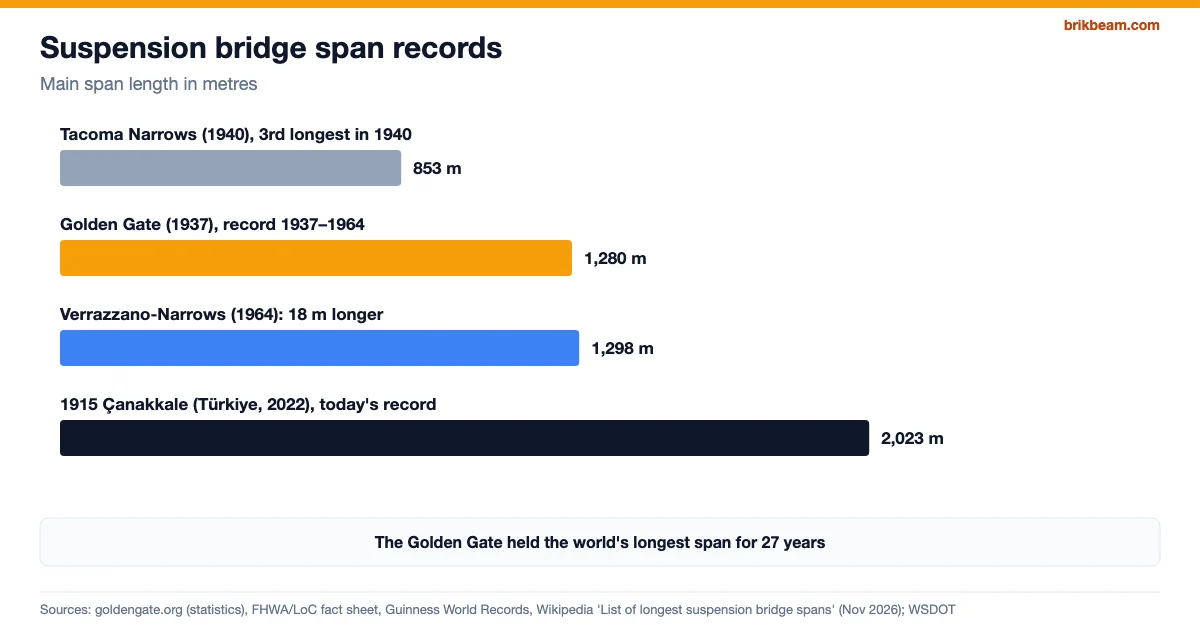
The 1,280 m span was the world's longest from 1937 until 1964, when the Verrazzano-Narrows Bridge in New York opened 18 m longer (1,298 m). Today's record is the 2,023 m span of the 1915 Çanakkale Bridge in Türkiye, opened in March 2022 (goldengate.org; Guinness; Wikipedia).
Why orange, and does the painting ever stop?
The name comes from the strait, which John C. Frémont named "Chrysopylae" (Golden Gate) in 1846, after the Golden Horn in Istanbul; that was two years before the Gold Rush (goldengate.org "What's in a Name"). The colour is another story. The steel arrived from Bethlehem Steel coated in a red lead primer of a reddish-orange shade. Architect Irving Morrow saw it on his ferry ride, and after colour trials "International Orange" was chosen: it blends with the hills and contrasts with the ocean and the sky (goldengate.org "Color & Art Deco"). The Navy reportedly wanted black and yellow stripes, and the Army Air Corps red and white; these accounts are secondary (NPR 2011; History.com).
Myth: "They paint the bridge from end to end, and when the painters finish they start again." According to the operator, painting is continuous but targeted: crews touch up the areas where salt in the air causes rust (goldengate.org "Painting the Bridge"). To estimate paint and labour for your own facade, use the BrikBeam paint calculator and the facade calculator.

The bridge today
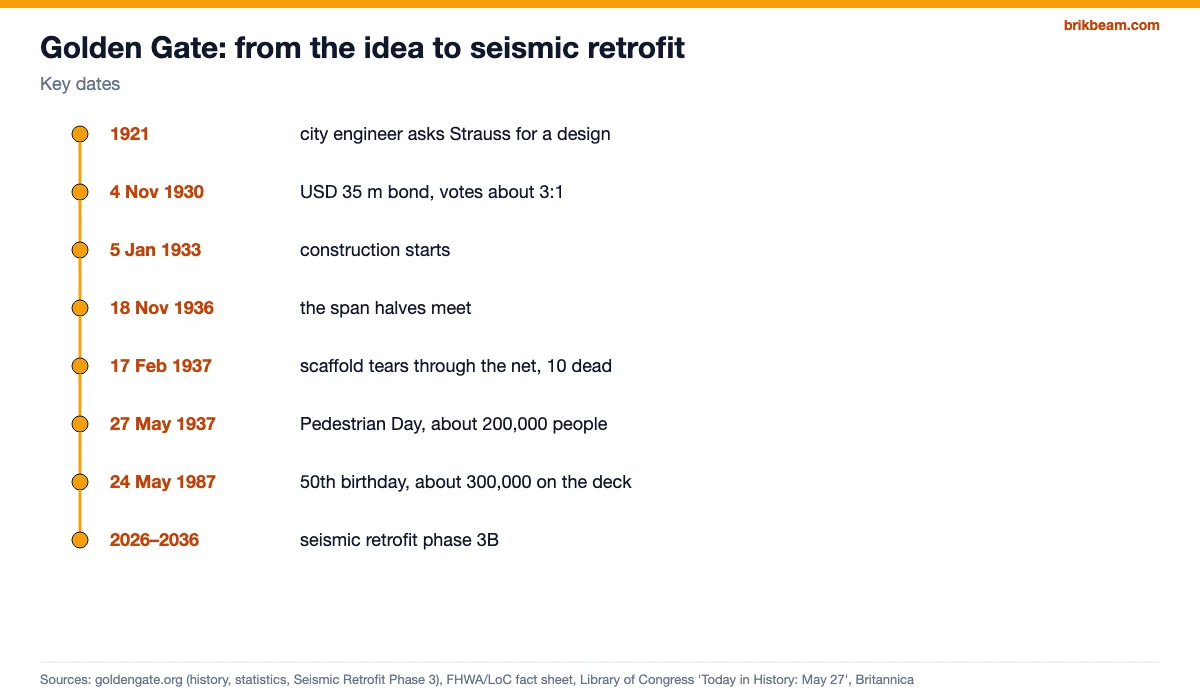
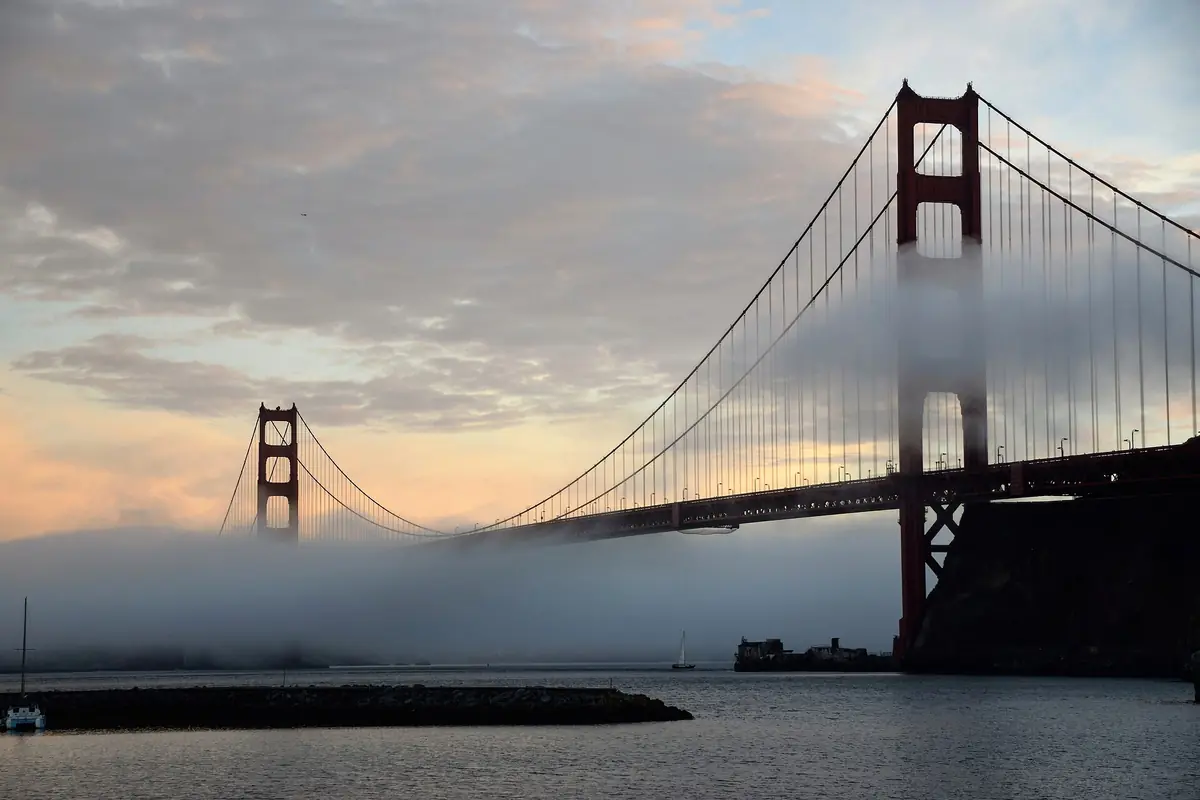
About 40 million vehicles cross the bridge each year (goldengate.org). Tolls are charged only southbound, into San Francisco; from 1 Jul 2026 the FasTrak toll is USD 10.25 (goldengate.org; Bay Area FasTrak). Seismic retrofit phase 3B is planned for 2026–2036 at USD 864 million (contract of October 2025), with 38 energy-dissipating devices (goldengate.org "Seismic Retrofit Phase 3").
What builders and investors can take from it
- Collective protection saves lives. The net saved 19 men, but one badly secured scaffold killed 10. On any site, check what happens if a single element fails (a scaffold, an anchor, a rope).
- The coating is part of the structure. The Golden Gate's colour came from an anti-corrosion primer, and painting is a permanent maintenance cost. With steel and facades, plan the recoating cycle from the start, not just the first coat.
- Spare capacity pays off. In 1987, 300,000 people on the deck caused a 2–3 m sag, with the cables at about 40% of their yield point. Codes require margins precisely for situations nobody foresaw.
The episode and Shorts
The full episode is embedded above (Polish audio). Shorts (Polish): Golden Gate, but the bridge is orange. Why?, 300,000 people on one bridge at once, The wire from this bridge would wrap the Earth 3 times, 1,280 metres: a world record for 27 years, In the Depression they pledged their homes to build this bridge.
Other episodes with articles: Megaprojects: all BrikBeam episodes.
▶ Subscribe to BrikBeam on YouTube: megaprojects worked out so you can check the maths.
Sources
- Golden Gate Bridge, Highway and Transportation District, goldengate.org: "Design & construction stats", "Bond Measure Passes", "Cross-section of a main cable", "All in a Day's Work", "What's in a Name", "Color & Art Deco", "Painting the Bridge", "Seismic Retrofit Phase 3", 2026 toll notice.
- FHWA / Library of Congress, "Golden Gate Bridge 1937" (fact sheet).
- Library of Congress, "Today in History: May 27".
- Britannica, "Golden Gate Bridge".
- Linda Hall Library (design history, Ellis and Moisseiff); HNN, 2007; ASCE, Journal of Professional Issues, 2009, "Justice at Last".
- WSDOT, Tacoma Narrows Bridge history (Moisseiff, opening on 1 Jul 1940).
- Guinness World Records; Wikipedia, "List of longest suspension bridge spans" (Nov 2026).
- Sausalito Historical Society / sfmuseum.org (1930 vote).
- NPR, 2011; History.com (Navy and Army Air Corps colour proposals, secondary sources).
- Bay Area FasTrak (2026 toll).
By the BrikBeam editorial team, 22 Nov 2026. Spotted a mistake? Tell us via the contact form.
Pobierz kompletny pakiet wzorów umów i protokołów budowlanych
Zyskaj natychmiastowy dostęp do prawnie sprawdzonych szablonów: Umowa o roboty budowlane, Umowa z podwykonawcą, Plan BIOZ, Protokół odbioru końcowego, Karta gwarancyjna i Harmonogram. Gotowe do edycji w Word i Excel.