The Fehmarnbelt tunnel by the numbers: how to sink 73,500 tonnes of concrete under the Baltic
A tunnel element weighs over 73,500 t and still floats. How Denmark is casting and sinking an 18 km tunnel between Denmark and Germany, what it costs, how much time it will save and why cars will not use it before 2032 at the earliest.
Between the Danish island of Lolland and the German island of Fehmarn, the world's longest immersed tunnel is taking shape. It is not bored under the seabed. It is cast on land in giant sections, towed out to sea and lowered into a trench dug in the bottom. The first element reached the seabed in May 2026. In the BrikBeam episode (Polish audio), Brik and Bzyk show how 73,500 tonnes of concrete can float. Here we collect the numbers, comparisons and timeline, with sources.
All data come from the fact sheet behind the episode; most are releases from the developer, Femern A/S, supplemented by Danish and German media. The full list is at the end.
Key numbers at a glance
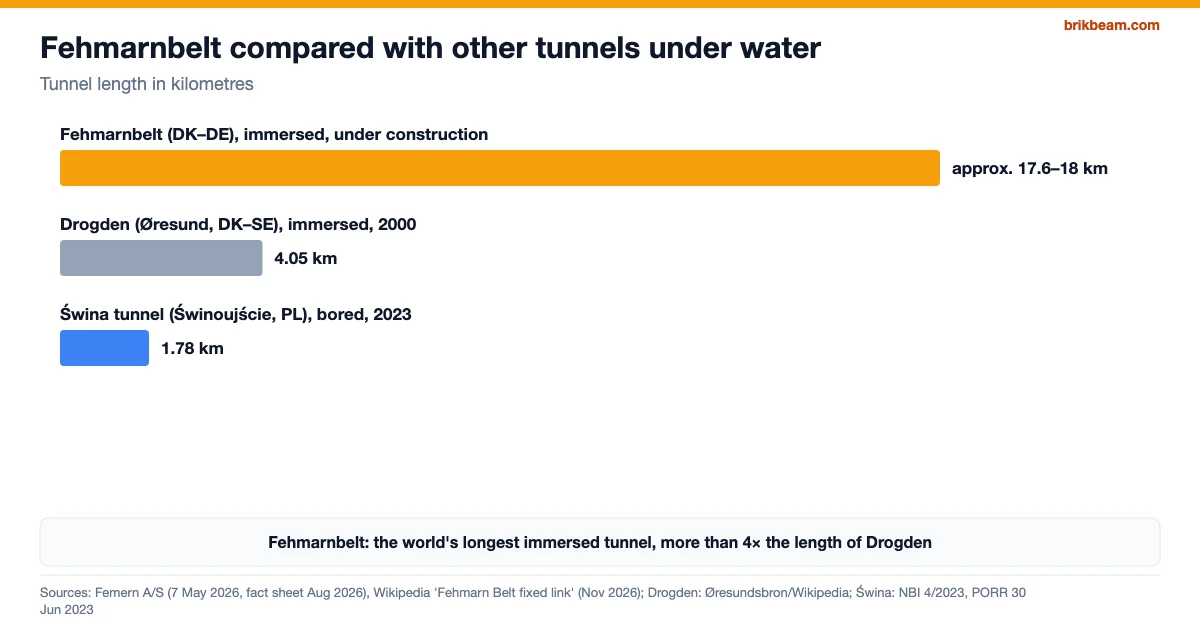
- About 18 km long (Wikipedia: 17.6 km), the world's longest immersed tunnel (Femern A/S, 7 May 2026; fact sheet Aug 2026).
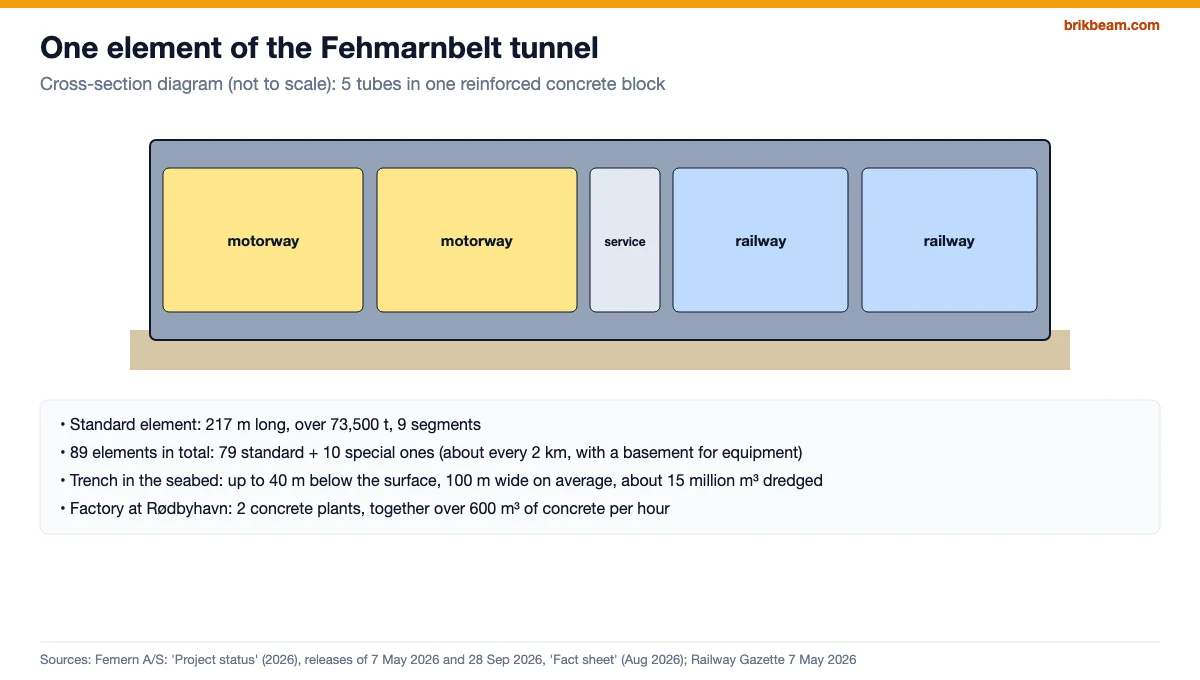
- 89 elements: 79 standard ones of 217 m and over 73,500 t each, plus 10 special ones (Femern A/S "Project status", fact sheet).
- Over 600 m³ of concrete per hour from two batching plants at the Rødbyhavn factory (Femern A/S "Project status").
- 10 min by car, 7 min by train instead of 45 min by ferry; Hamburg–Copenhagen by train in about 2.5 h instead of about 5 h (fact sheet Aug 2026; Femern A/S, 7 May 2026).
- DKK 52.6 billion: the construction budget approved in 2015, at 2015 prices (Wikipedia, citing Sund & Bælt).
▶ From our YouTube channel
Tunel pod Bałtykiem: jak zatopić 73 500 ton betonu?Brik and Bzyk do the maths on megastructures — an episode about the Fehmarnbelt tunnel under the Baltic. Audio in Polish. Watch on YouTube ↗
How an immersed tunnel is built
An immersed tunnel goes in four steps:
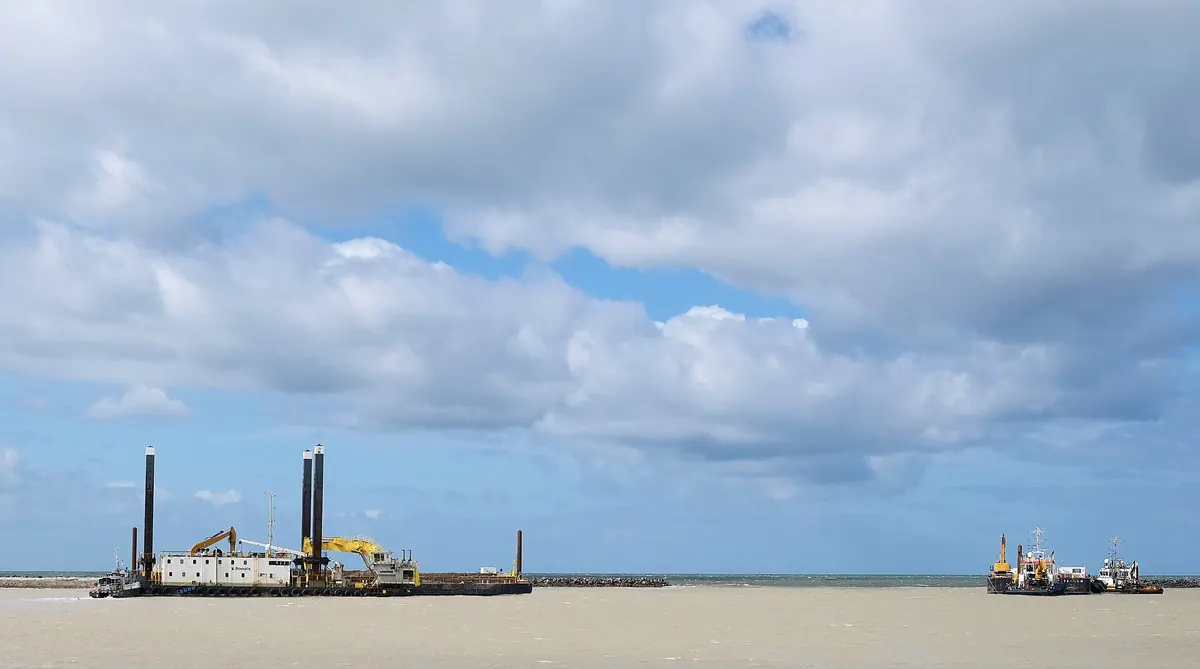
- A trench in the seabed. Dredgers dug a channel on average 100 m wide and 12 m deep, reaching down to 40 m below the surface at its deepest. About 15 million m³ were dredged, and the trench was finished in 2024 (Femern A/S "Project status"; fact sheet Aug 2026).
- A factory on land. Rødbyhavn has three halls with five production lines for standard elements and a sixth for special ones. A standard element is made of nine segments (Femern A/S "Project status").
- Floating. The ends of an element are closed with bulkheads, so the inside stays full of air and the concrete box floats. The basins in front of the factory are flooded like a lock and the element floats out to the harbour (fact sheet Aug 2026).
- Immersion. Special pontoons lower the element into the trench as ballast is added (about 4,500 t of ballast concrete), and hydraulic arms pull it tight against the previous one. Its position is checked by laser from inside. Then the sides are backfilled with gravel and sand and a stone layer goes on top (Femern A/S, 7 May 2026; Railway Gazette, 7 May 2026).

The first element left the factory late in the evening of 4 May 2026, with five tugs and the IVY pontoons. Lowering began around noon on 6 May and took about 14 hours (Femern A/S, 7 May 2026).
Myth: "Fehmarnbelt is the longest tunnel under water." No: bored tunnels such as Seikan in Japan or the Channel Tunnel have longer sections under the sea. Fehmarnbelt is the longest immersed tunnel.
Why 73,500 t of concrete floats
This is Archimedes' principle at work. The element is a closed box with empty tubes inside, so it displaces enough water for the weight of that water to balance the weight of the concrete. To make the box sink in a controlled way, ballast is added: first in tanks, then as ballast concrete (Femern A/S, 11 Sep 2026; Railway Gazette, 7 May 2026). Once it is on the bottom and covered with stone, the element will not rise again.
For comparison with an earlier episode of ours: the Drogden tunnel under the Øresund has 20 elements of about 55,000 t and is 4,050 m long. Fehmarnbelt is more than four times longer.
Concrete and logistics: a lesson for any site
The factory produces over 600 m³ of concrete an hour and employs over 2,000 people from more than 40 countries (Femern A/S "Project status"; the fact sheet mentions about 2,000 on the Danish side). By 28 Sep 2026, 16 standard elements and three special ones had been cast (Femern A/S, 28 Sep 2026).
How much concrete goes into one element? The developer does not publish the volume directly, but it can be estimated from the weight. At a reinforced concrete density of about 2.5 t/m³: 73,500 t ÷ 2.5 ≈ 29,400 m³ per element. That is our own estimate, give or take the concrete type and the amount of steel. At 600 m³/h, that is about 49 hours of concrete production alone, or two days of the batching plants per element. With 8 m³ mixer trucks it would be about 3,700 loads, which is why the plants sit right next to the factory.
The same principle applies on a house build: the closer the batching plant and the better the volume is calculated, the lower the risk of a break in the pour. Work out the volume of footings, a slab or a floor with the BrikBeam concrete calculator.
Special elements: a basement every two kilometres
About every 2 km there is a special element, shorter and taller: 39 × 47 × 13 m, "like a four-storey building". It has a basement for electrical equipment and a lay-by for a service vehicle at road level (Femern A/S, 28 Sep 2026 and 11 Sep 2026). The elements are named after cities on the Scandinavian–Mediterranean transport corridor; the fourth is called "Nykøbing Falster" (Femern A/S, 28 Sep 2026).
How much time the tunnel will save
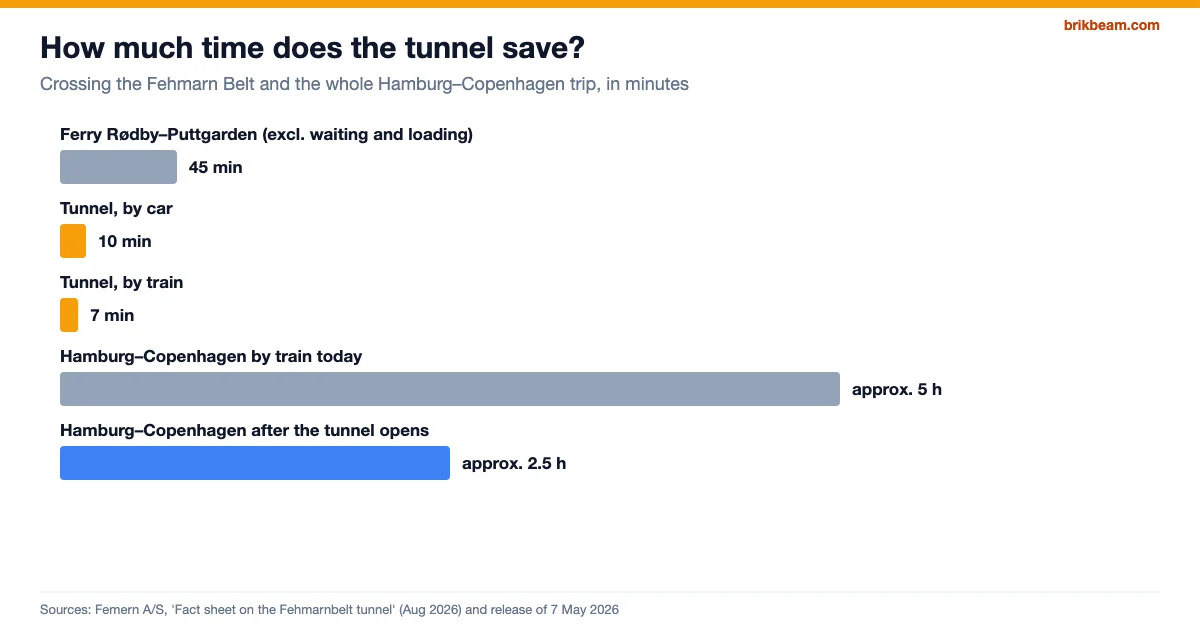
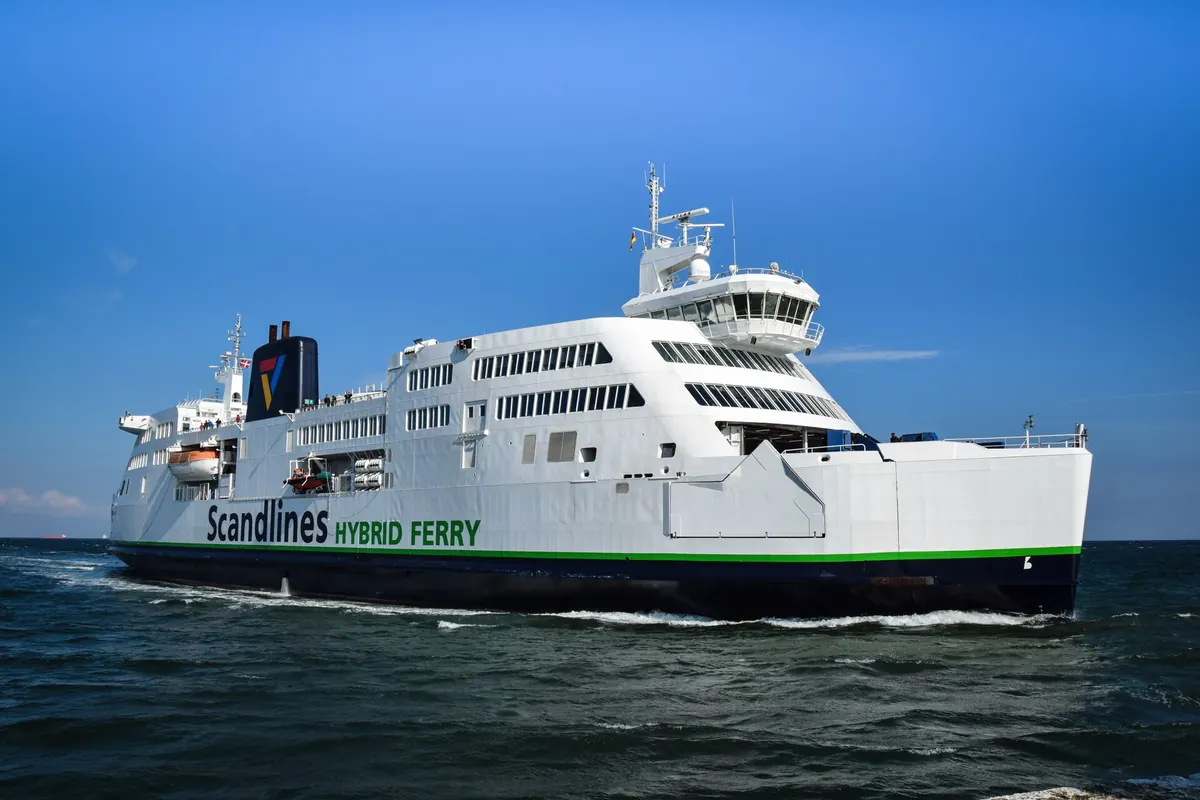
The Rødby–Puttgarden ferry takes 45 minutes, not counting waiting and loading. Through the tunnel the crossing will take 10 minutes by car and 7 by train, and a rail trip from Hamburg to Copenhagen will drop from about 5 hours to about 2.5 (fact sheet Aug 2026; Femern A/S, 7 May 2026).

Why a tunnel and not a bridge
A bridge of about 20 km with pylons of about 280 m had been considered earlier. In December 2010 Femern A/S recommended a tunnel: lower construction risk at a similar cost. In January 2011 a large majority of the Danish parliament backed it (Wikipedia "Fehmarn Belt fixed link", Nov 2026).
The money
The construction budget approved in 2015 is DKK 52.6 billion at 2015 prices (Wikipedia, citing Sund & Bælt). The European Union contributes about EUR 1.3 billion (Femern A/S, 7 May 2026). The rest is financed by loans guaranteed by the Danish state and repaid from tolls and rail fees (fact sheet Aug 2026).
Timeline and delay
| Date | Event | Sources |
|---|---|---|
| Dec 2010 / Jan 2011 | tunnel chosen over a bridge, backed by the Danish parliament | Wikipedia |
| 2015 | budget of DKK 52.6 billion (2015 prices) | Wikipedia citing Sund & Bælt |
| 2024 | trench in the seabed fully dug | Femern A/S "Project status"; fact sheet |
| Jan 2026 | immersion delayed by 2 years | NDR 16 Jan 2026; dpa (Jan 2026) |
| 6–7 May 2026 | first element on the seabed | Femern A/S 7 May 2026; Railway Gazette |
| 17 May 2026 | opening in two stages: road first, rail later | Femern A/S 17 May 2026; DR 17 May 2026 |
| Sep 2026 | 4 elements on the seabed, almost 900 m | Femern A/S 28 Sep 2026 and 11 Sep 2026 |
| 30 Oct 2026 | structural works on the German portal completed | Femern A/S 30 Oct 2026 |
| 2032 at the earliest | cars in the tunnel (according to DR/Børsen) | DR 17 May 2026 |
The tunnel was originally due to open in 2029. According to the developer and the media, the delay comes from problems with the special immersion vessel (the Danish side is about 2 years behind plan) and from the conditions of the German permit, including underwater noise limits and restrictions on where and when work may take place in German waters. On top of that, the German rail link on land will not be ready in 2029 (Femern A/S, 17 May 2026; DR, 17 May 2026). Sund & Bælt has not given a new opening date; 2032 for cars comes from Danish broadcaster DR.
What builders and investors can take from it
- Precasting moves risk from the site into the factory. Concrete cures under a roof in repeatable conditions, and only assembly happens at sea. The same logic is behind hollow-core floor slabs and panelised houses.
- Concrete logistics sets the pace. 600 m³/h is possible only because the plants are next to the factory. On a small site, the distance to the batching plant and the truck queue are part of the schedule too.
- Permits can move a deadline more than engineering. Noise limits and time windows for marine works are formal conditions, and they cost years. Plan the schedule together with the permit conditions, not alongside them.
- Spoil can be a resource. The dredged material is creating about 300 ha of new nature and recreation land next to Lolland; the first part (30 ha) opened on 1 Sep 2026 (Femern A/S, 2 Sep 2026; fact sheet).
The episode and Shorts
The full episode is embedded above (Polish audio). Shorts on this topic (Polish): 73,500 t of concrete, and it floats, The tunnel factory: over 600 m³ of concrete an hour, 2 years late. Why?, Denmark grew by 30 hectares, How do you sink a tunnel block?, Why not a bridge?.
Other episodes with articles: Megaprojects: all BrikBeam episodes. Another tunnel from the series, bored rather than immersed: the Świna tunnel by the numbers.
▶ Subscribe to BrikBeam on YouTube: megaprojects worked out so you can check the maths.
Sources
- Femern A/S, "Project status", femern.com, as of autumn 2026.
- Femern A/S, "The first element… successfully immersed", 7 May 2026.
- Femern A/S, "Fact sheet on the Fehmarnbelt tunnel", Aug 2026 (PDF).
- Femern A/S, "The Fehmarnbelt Tunnel will open in two stages", 17 May 2026.
- DR, "Femern Bælt-forbindelsen bliver først brugbar for bilister i 2032", 17 May 2026.
- Femern A/S, "…approaching its first kilometre", 28 Sep 2026.
- Femern A/S, "Immersion Pontoon IVY ready…", 11 Sep 2026.
- Femern A/S, "Denmark grows larger…", 2 Sep 2026.
- Wikipedia, "Fehmarn Belt fixed link", Nov 2026 version (bridge history, 2010/2011 decision, 2015 budget citing Sund & Bælt).
- Railway Gazette, 7 May 2026 (ballast, immersion).
- NDR, 16 Jan 2026; dpa (Jan 2026): two-year immersion delay.
- Femern A/S, "German tunnel portal: structural works completed", 30 Oct 2026.
By the BrikBeam editorial team, 22 Nov 2026. The concrete volume per element is our estimate from its weight (density 2.5 t/m³). Spotted a mistake? Tell us via the contact form.
Pobierz kompletny pakiet wzorów umów i protokołów budowlanych
Zyskaj natychmiastowy dostęp do prawnie sprawdzonych szablonów: Umowa o roboty budowlane, Umowa z podwykonawcą, Plan BIOZ, Protokół odbioru końcowego, Karta gwarancyjna i Harmonogram. Gotowe do edycji w Word i Excel.