The Panama Canal by the numbers: how the locks work, where the water comes from and how much concrete it took
Locks with no pumps, 197,000 m³ of fresh water per ship, 3.44 million m³ of concrete in the 1914 locks and a drought that forced the first traffic limits in the canal's history. The Panama Canal, worked out step by step.
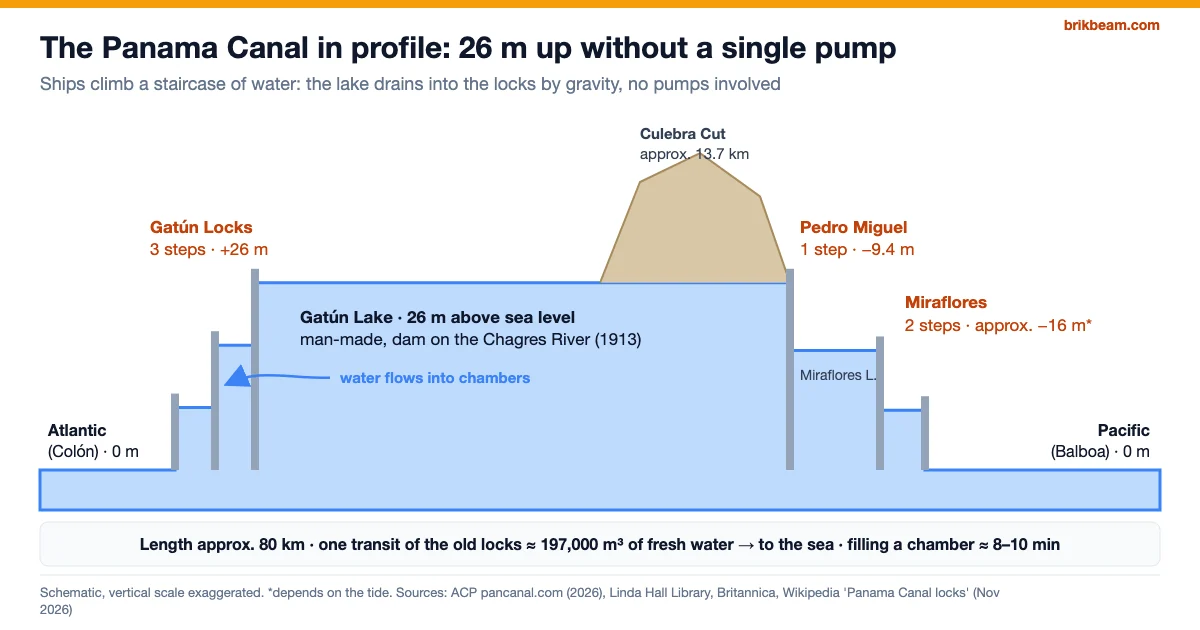
At heart, the Panama Canal is a lift for ships that runs on rain. A ship from the Atlantic climbs three water "steps" to a lake 26 m above the sea, crosses the isthmus and steps back down to the Pacific. Not a single pump is involved: gravity and fresh water from Gatún Lake do all the work. Since 2023, that same system has turned out to be the canal's weak spot.
In the BrikBeam episode on YouTube (Polish audio), Brik and Bzyk show it in motion. This article covers what does not fit into a video: chamber dimensions, the concrete converted into a cube and into truck loads, the water balance during the drought and a dated table of traffic limits. Every number comes with its source, and the full list is at the end.
Key numbers at a glance
- About 80 km from the Atlantic to the Pacific (ACP, Britannica; Wikipedia gives 82 km).
- 26 m above sea level: the height of Gatún Lake, the "upper floor" the ships climb to (ACP; Britannica: 85 ft).
- About 197,000 m³ of fresh water flows out to sea for every transit of the old locks, roughly 79 Olympic pools (Linda Hall Library, ASME).
- 3.44 million m³ of concrete in the 1914 locks and about 5 million m³ in the 2016 locks (Linda Hall Library; Sacyr, Webuild).
- 2023: for the first time ever, the canal had to limit the number of ships because it was short of water (ACP, 15 Dec 2023).
▶ From our YouTube channel
Kanał Panamski: jak statek wspina się 26 m po wodzie?Brik and Bzyk do the maths on megastructures — an episode about the Panama Canal locks. Audio in Polish. Watch on YouTube ↗
How a ship climbs 26 m without a single pump
A lock is a concrete chamber with gates at both ends. To raise a ship, operators open valves in culverts hidden inside the walls: water from the chamber above (and, at the top, from the lake) flows down on its own, enters through openings in the floor and lifts the ship. To lower it, the water is released downhill, eventually into the sea. The main wall culverts are 6.71 m (22 ft) across and narrow to 5.49 m (Wikipedia "Panama Canal locks"; Linda Hall Library).
Filling one old chamber takes about 101,000 m³ of water (26.7 million US gallons) in roughly 8 to 10 minutes. Linda Hall Library says "about 8 minutes", Wikipedia "as little as ten minutes".
The 26 m is not climbed in one go. On the Atlantic side, the Gatún Locks have three steps that lift a ship about 25.9 m in total. On the Pacific side the descent is split: Pedro Miguel (one step, 9.4 m) and two steps at Miraflores (about 16 m). That last figure changes with the ocean tide, from 13 m at extreme high tide to 20 m at extreme low tide (Wikipedia "Panama Canal locks", Nov 2026).
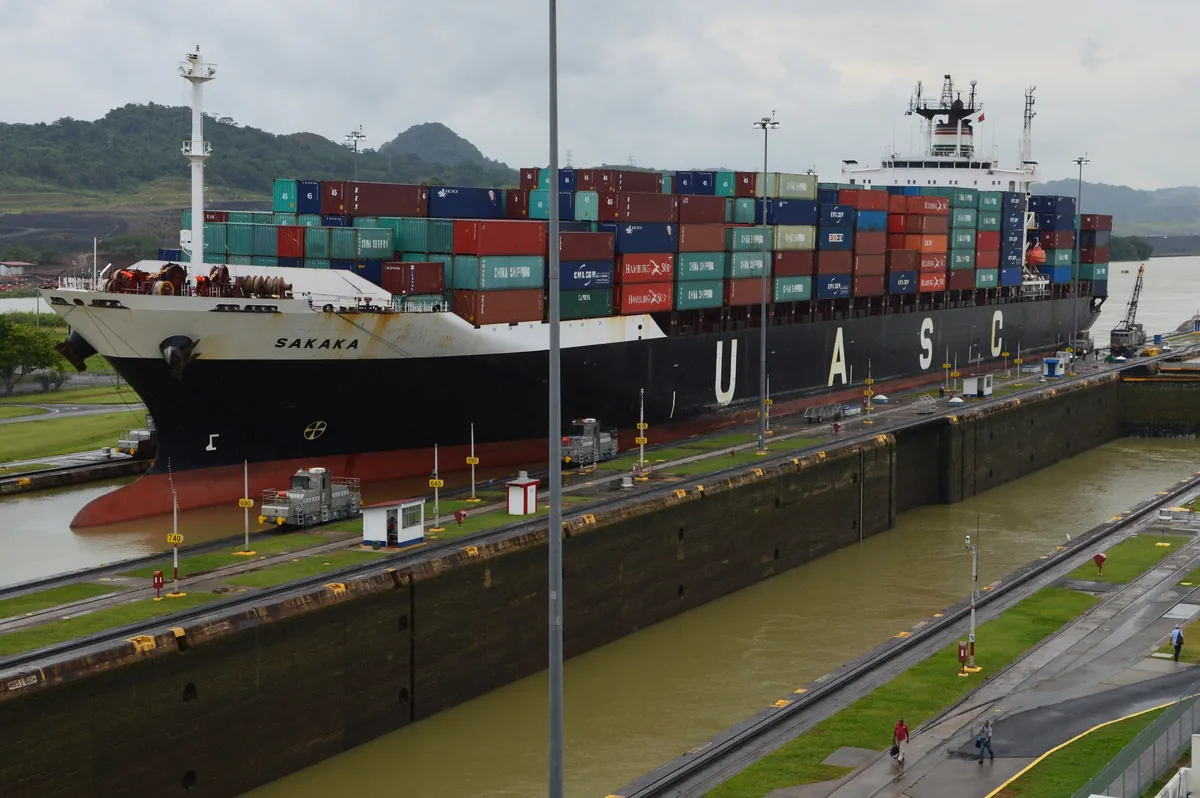

The old gates are steel leaves 19.8 m wide and 2.1 m thick. The heaviest weigh about 700 tonnes (sources range from 662 to about 790 t). Even so, two 19 kW motors per leaf are enough to swing them, because the leaves are hollow and partly float when the chamber is full (Linda Hall Library; Wikipedia).
Myth: "Pumps lift the ships." No. The water only ever flows downhill, from the lake into the chambers and from the chambers into the sea. That is exactly why the canal is so sensitive to a lack of rain.
Old and new locks at the same scale
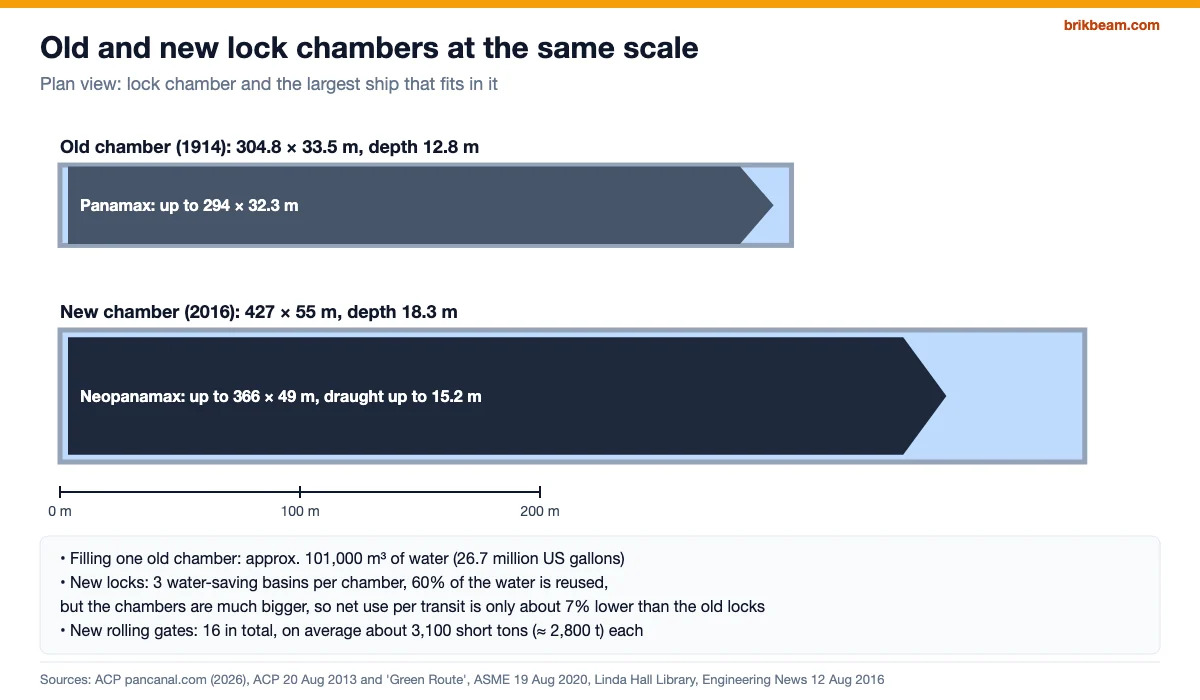
In 2016 a third set of locks opened (Agua Clara on the Atlantic side, Cocolí on the Pacific side) for Neopanamax ships. The difference is clearest when both chambers are drawn to the same scale.
| Item | Old locks (1914) | New locks (2016) | Sources |
|---|---|---|---|
| Chamber (length × width) | 304.8 × 33.5 m | 427 × 55 m | ACP; Linda Hall; ASME 2020 |
| Chamber depth | about 12.8 m (42 ft) | 18.3 m (60 ft) | ASME 19 Aug 2020; Wikipedia |
| Largest ship | Panamax: 294.1 × 32.3 m | Neopanamax: up to 366 × 49 m, draught up to 15.2 m | ACP; Engineering News 12 Aug 2016 |
| Gates | 46 mitre gates, leaves of about 700 t | 16 rolling gates, about 2,800 t on average | Linda Hall; ACP 20 Aug 2013 |
| Water saving | none | 3 basins per chamber, 60% of the water reused | ACP "Green Route"; ASME 2020 |
This is where people often get it wrong. The water-saving basins recover 60% of the water from each lockage, but the chambers are far bigger. Net, the new locks use about 7% less water per transit than the old ones, not "60% less" as is often repeated (ACP "Green Route Strategy"; ASME, 19 Aug 2020).
The new gates were built in Italy (by Cimolai) and shipped four at a time; the first batch reached Panama on 20 Aug 2013 (ACP). Each is 57.6 m long and over 30 m high.
How much concrete, and how to work it out yourself
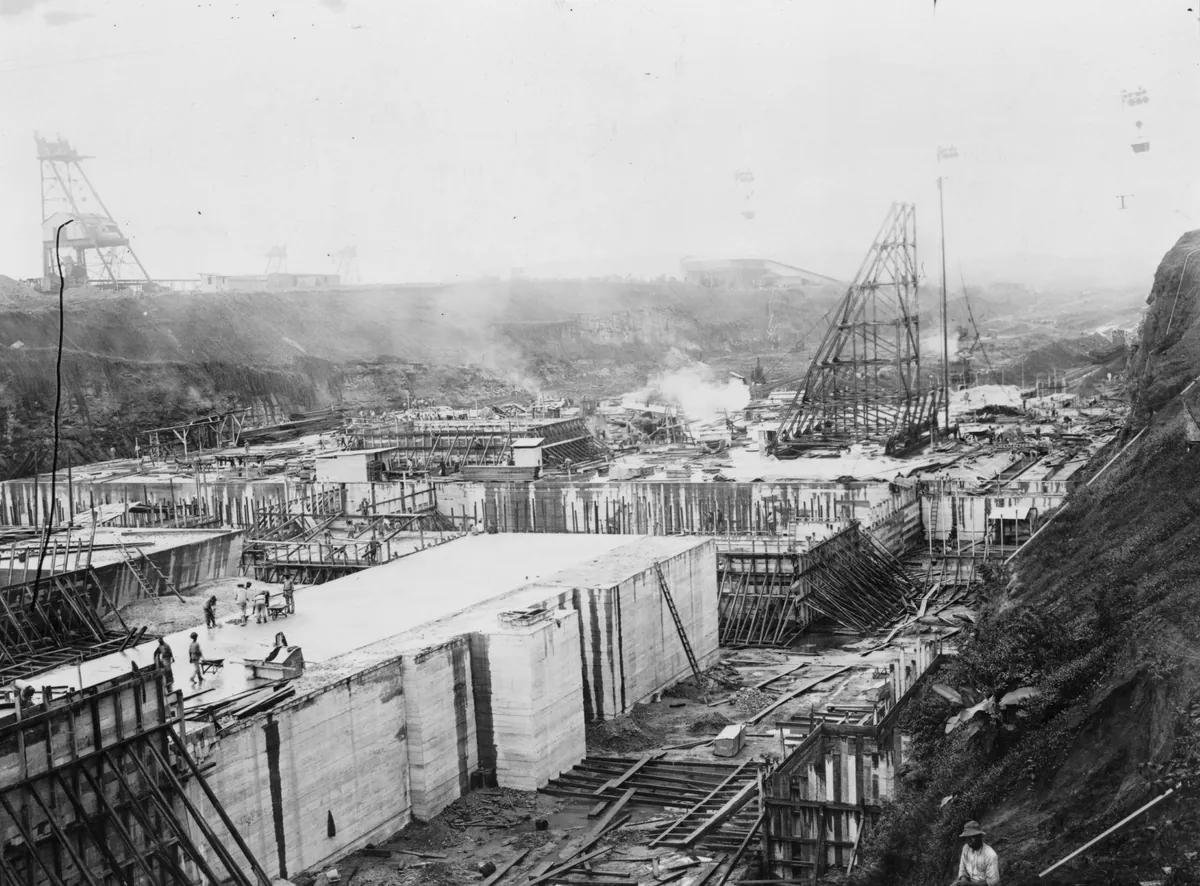
Linda Hall Library says the three sets of old locks used "nearly 4,500,000 cubic yards" of concrete. Conversion: 1 cubic yard = 0.7646 m³, so 4,500,000 × 0.7646 ≈ 3.44 million m³. The Gatún flight alone took over 2 million cubic yards, about 1.56 million m³ (Linda Hall Library; Wikipedia). According to the main contractor (the GUPC consortium led by Sacyr, with Webuild), the new locks took about 5 million m³ (Sacyr, 26 Jun 2019; Webuild).
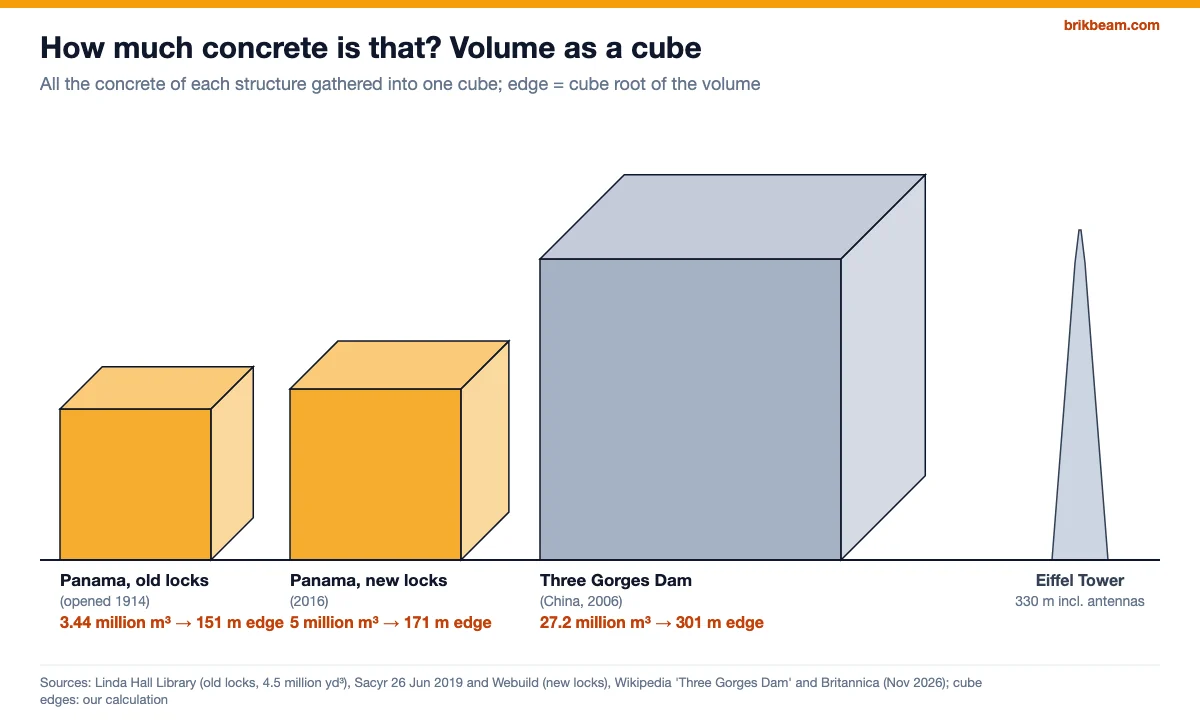
Numbers like that are hard to picture, so we turn them into a cube. The edge of the cube is the cube root of the volume:
- 3.44 million m³ → ∛3,440,000 ≈ 151 m,
- 5 million m³ → ∛5,000,000 ≈ 171 m,
- for comparison, the Three Gorges Dam: 27.2 million m³ → about 301 m, close to the height of the Eiffel Tower (330 m including antennas).
How we worked it out (you can repeat it for your own site):
- Convert to m³ (cubic yards × 0.7646, cubic feet × 0.0283).
- Divide by the truck capacity. With a typical 8 m³ mixer, the old locks equal about 430,000 truckloads and the new ones about 625,000.
- Cube edge = volume to the power of 1/3; in a spreadsheet:
=POWER(3440000,1/3).
On a house build you do exactly the same at a smaller scale: how many m³ for the footings, slab or floor, and how many truckloads to order. The BrikBeam concrete calculator does it for you, and for masonry walls there is the block and brick calculator.

Water: why the canal had to cut traffic
One transit of the old locks uses about 52 million US gallons, roughly 197,000 m³ of fresh water, which ends up in the sea (Linda Hall Library; ASME). That is about 79 Olympic pools of 2,500 m³ for a single ship. The water comes from rain draining into Gatún Lake and the Alhajuela reservoir. The rainy season normally runs from May to November.
In 2023, rainfall in the watershed was 25.6% below the 73-year average, and October was the driest since 1950. According to the ACP, in October 2023 about 7 million m³ a day flowed into the lake while about 10 million m³ a day left it (canal, evaporation, drinking water, industry), a deficit of about 3 million m³ per day (ACP, 3 Oct 2023). The same lakes supply drinking water to roughly half of Panama's population: the ACP put it at 55% (ACP, 11 Oct 2023), ENR in 2026 at about 2 million people.
The result, in the ACP's own words: the first time the canal had ever had to restrict transits (ACP, 15 Dec 2023).
| Period | Transits per day | Sources |
|---|---|---|
| Normal (before the crisis) | 36 (26 Panamax + 10 Neopanamax) | ACP 15 Dec 2023; World-Grain (advisory A-48-2023) |
| from 1 Nov 2023 | 31 on average | ACP 11 Oct 2023; Wikipedia |
| December 2023 (low point) | 22 | ACP 15 Dec 2023; gCaptain 11 Nov 2026 |
| from 16 Jan 2024 | 24 | ACP 15 Dec 2023; Wikipedia |
| September 2026 (El Niño) | cut from 34 to 32 | Maritime Executive 20 Aug 2026; Newsroom Panama 23 Aug 2026 |
| from 9 Nov 2026 | 34, Neopanamax draught back to 50 ft (15.24 m) | gCaptain 11 Nov 2026; Marine Insight (Nov 2026); ACP advisory 9 Nov 2026 |
Myth: "In February 2024 only 18 ships a day got through." The figure of 18 comes from a plan announced in October 2023 that the ACP cancelled. The lowest actual level was 22 a day in December 2023.
The fix is meant to be a new reservoir on the Río Indio with a transfer tunnel to Gatún Lake. The ACP board approved the funding in February 2025; the cost is about USD 1.6 billion and water for the canal is expected around 2032 (Sourcing Journal, 26 Feb 2025; ENR, 24 Jun 2026). Dates and the number of families to be resettled differ between sources, so treat them as a plan, not a certainty.
Tolls: from 36 cents to USD 5.3 million
The lowest toll in the canal's history was paid in 1928 by Richard Halliburton, who swam the canal: 36 cents (Guinness World Records; Wikipedia). The record at the other end of the scale is often misreported. The USD 5.3 million that SK Gas paid for an LPG carrier's transit on 1 Sep 2026 was an auction fee for priority in the queue, paid on top of the regular toll, not the toll itself (FreightWaves, 31 Aug 2026; Maritime Executive, 20 Aug 2026).
History in brief
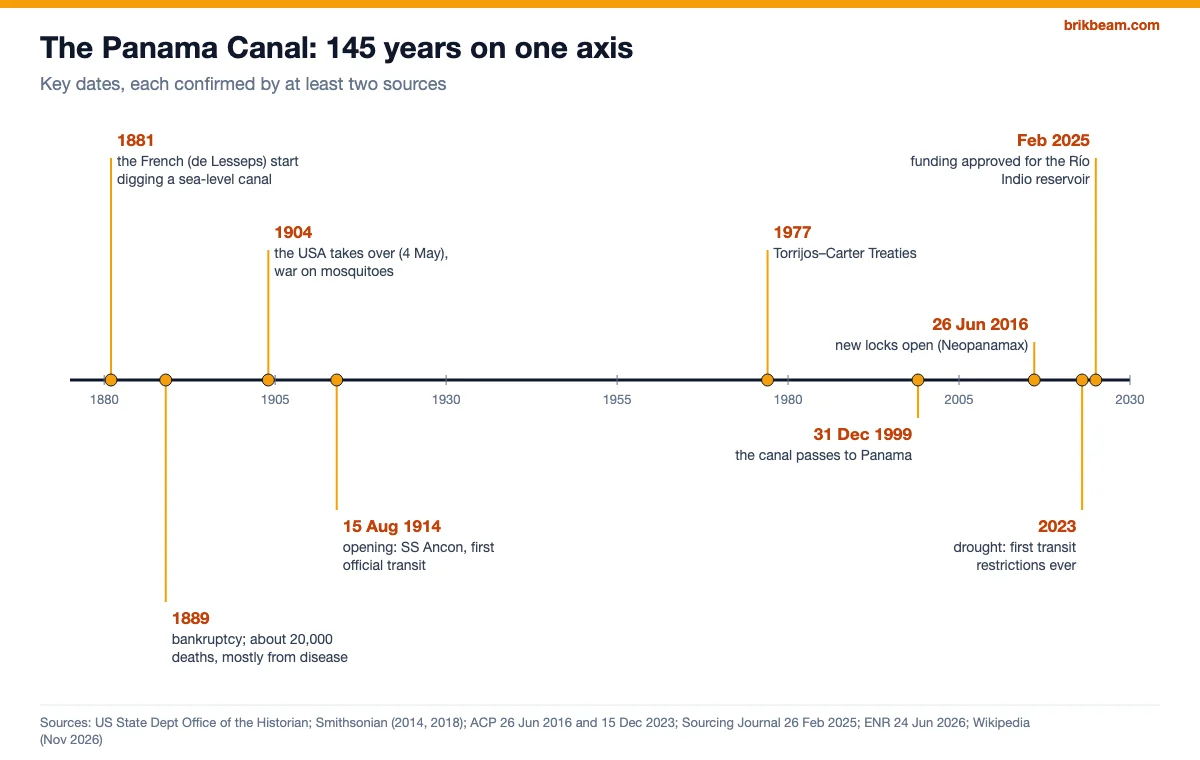
The French, led by Ferdinand de Lesseps of Suez Canal fame, started digging a sea-level canal without locks in 1881. The project went bankrupt in 1889. About 20,000 people died, mostly of malaria and yellow fever (US State Dept; Smithsonian, 2018). The often-quoted "22,000" is an estimate, because the French counted only deaths in hospitals.
The United States took over on 4 May 1904 and switched to a lock canal with an artificial lake. Colonel William Gorgas nearly eliminated mosquito-borne disease within about two years. Hospital records list 5,609 deaths between 1904 and 1914 (old ACP FAQ; Wikipedia). The canal opened on 15 Aug 1914 with the SS Ancon, the first official transit; earlier, on 7 Jan 1914, the crane boat Alexandre La Valley had already made the crossing (Wikipedia; Smithsonian Institution Archives, 2014). Under the 1977 Torrijos–Carter Treaties, the canal passed to Panama on 31 Dec 1999.
What builders and investors can take from it
- Gravity is the cheapest energy, but it has a limit. The canal pays nothing for pumps; it pays in rain. Any project that relies on a natural resource (groundwater, dewatering a dig, supply from a well) has to be checked against a bad year, not an average one.
- At this scale, concrete is mainly logistics. 625,000 truckloads for the new locks is a challenge for roads, batching plants and the schedule, not only for the mix design. A small site works the same way: order concrete without a margin and you end up with a cold joint.
- Bigger is not automatically more efficient. The new locks recover 60% of their water and still save only about 7% net, because the chambers are so much larger. With any "green" technology, ask for the net balance.
Myths at a glance
- "Pumps lift the ships": false, it is gravity only.
- "A ship climbs 26 m in a single lock": no, Gatún has three steps of about 8.6 m each.
- "The new locks use 60% less water": no, 60% of the water is recycled through basins; the net saving is about 7%.
- "A record USD 5.3 million toll": it was an auction fee for a slot, not a toll.
- "The Ancon was the first ship through the canal": the first official transit; the crane boat Alexandre La Valley went through earlier.
Watch the episode and Shorts
The full episode is embedded above (Polish audio). Short clips on this topic appear in the BrikBeam Shorts tab. All the megaprojects in the series, with their articles, are listed in Megaprojects: all BrikBeam episodes. From the same series: the Three Gorges Dam by the numbers, where ships climb 113 m rather than 26.
▶ Subscribe to BrikBeam on YouTube: a new megaproject every week, worked out so you can check the maths.
Sources
- Panama Canal Authority (ACP), "History of the Panama Canal", pancanal.com, as of 2026.
- Linda Hall Library, "The Land Divided, The World United", chapter 08 "Locks" (digital exhibition).
- Britannica, "Timeline and map of the Panama Canal".
- Wikipedia, "Panama Canal locks" and "Panama Canal", Nov 2026 versions (secondary source).
- ACP, "Massive new gates for expanded Panama Canal arrive in Panama", 20 Aug 2013.
- ACP, "Green Route Strategy" (ACP website).
- ASME, "Panama Canal Expands to Meet Demand", 19 Aug 2020.
- ACP, "Game changer: inauguration of the expanded Panama Canal…", 26 Jun 2016.
- Sacyr, "Fin contrato Panamá", 26 Jun 2019; Webuild, "Expansion of the Panama Canal – Third set of locks".
- ACP, "How the Canal manages the fresh water challenge", 3 Oct 2023; ACP statement of 11 Oct 2023.
- ACP, "Panama Canal to increase daily transits to 24 starting in January", 15 Dec 2023.
- World-Grain, "Panama Canal further limits daily vessel transits" (advisory A-48-2023), Oct/Nov 2023.
- Sourcing Journal, "Panama Canal Board Approves Plans for New Reservoir…", 26 Feb 2025.
- ENR, "New Panama Canal chief takes on next wave of megaprojects", 24 Jun 2026.
- Maritime Executive, "Panama Canal begins reducing daily transits due to declining water levels", 20 Aug 2026; Newsroom Panama, 23 Aug 2026.
- gCaptain, "Panama Canal raises daily transit capacity as water conditions improve", 11 Nov 2026; Marine Insight, "Panama Canal raises daily transits to 34 and restores 50-foot Neopanamax draft", Nov 2026.
- FreightWaves, "$5.3 million a new record for Panama Canal transit", 31 Aug 2026.
- Guinness World Records, "Lowest toll – Panama Canal".
- US Department of State, Office of the Historian, "Building the Panama Canal, 1903–1914"; Smithsonian Magazine (2018); Smithsonian Institution Archives (2014).
- Engineering News, "Panama Canal expansion project", 12 Aug 2016.
By the BrikBeam editorial team, 22 Nov 2026. The infographics are our own, drawn from the numbers in the sources above; the profile diagrams are not to vertical scale. Spotted a mistake? Tell us via the contact form.
Pobierz kompletny pakiet wzorów umów i protokołów budowlanych
Zyskaj natychmiastowy dostęp do prawnie sprawdzonych szablonów: Umowa o roboty budowlane, Umowa z podwykonawcą, Plan BIOZ, Protokół odbioru końcowego, Karta gwarancyjna i Harmonogram. Gotowe do edycji w Word i Excel.