Tacoma Narrows 1940 by the numbers: why the bridge fell in a wind under 70 km/h, and why it was not simple resonance
On 7 November 1940 the Tacoma Narrows Bridge twisted itself apart in a wind of about 65–70 km/h. The numbers: deck slenderness, wind pressure, oscillation frequencies, why the famous film is sped up and how flutter differs from resonance.
Almost everyone who took physics at school has seen the film from 7 November 1940: the deck of the Tacoma Narrows Bridge in Washington State twists like a ribbon and then falls into the water. It is usually captioned with one word, "resonance". That explanation is incomplete, and the film itself runs about 50% too fast. In the BrikBeam episode (Polish audio), Brik and Bzyk take the collapse apart in numbers. Here we collect them with sources.
The facts come from the episode's fact sheet (checked on 7 Nov 2026): the bridge history compiled by the Washington State Department of Transportation (WSDOT), the HAER documentation at the Library of Congress, the 1991 paper by Billah and Scanlan, and a 2015 article in Physics Today. Metric conversions are ours (1 ft = 0.3048 m, 1 mph = 1.609 km/h). The full list is at the end.
Key numbers at a glance
- 853 m centre span, the third longest in the world in 1940 (WSDOT; UW).
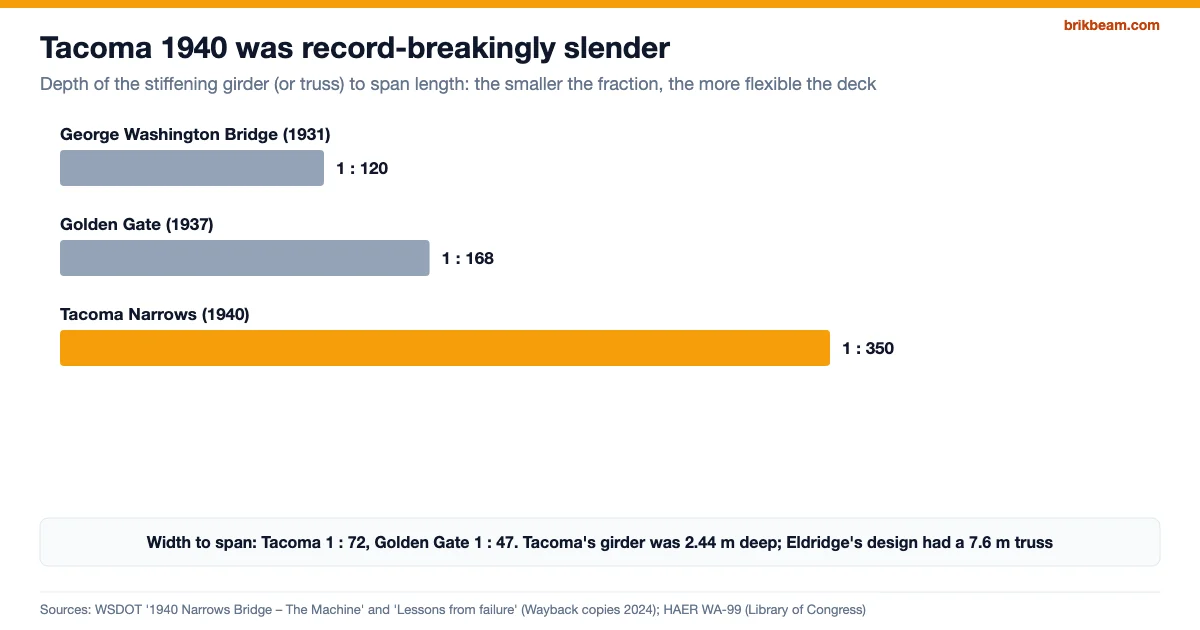
- 1:350: girder depth to span length; the Golden Gate had 1:168 (WSDOT).
- 2.4 kPa (50 psf) design wind pressure against about 0.24 kPa (5 psf) on the day of the collapse (HAER WA-99).
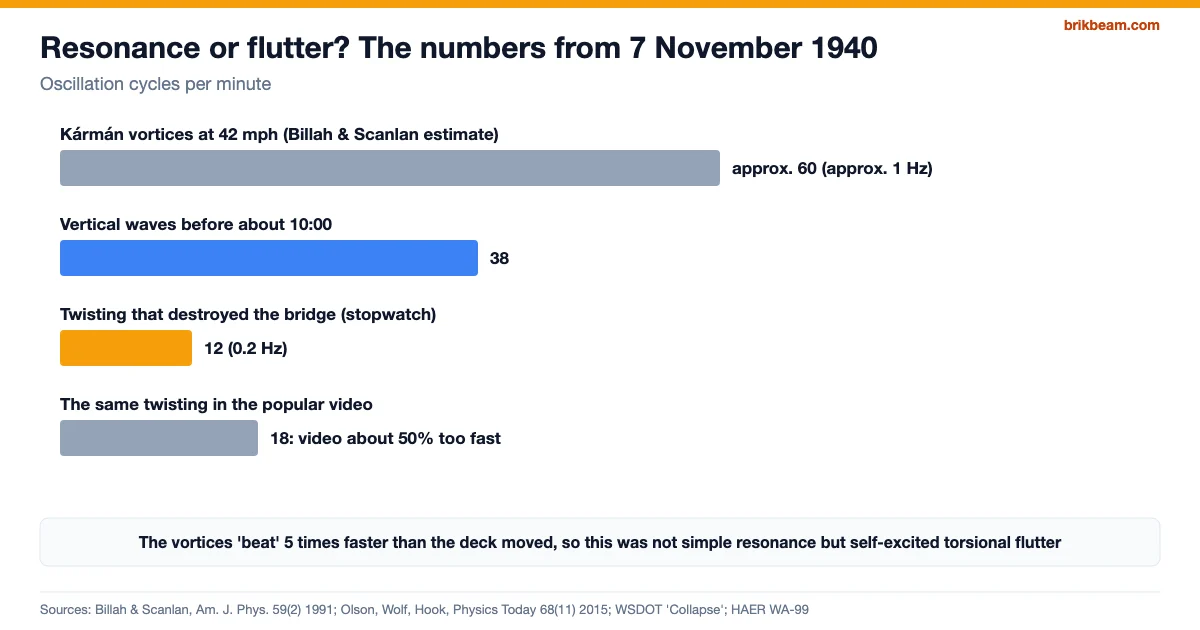
- 12 cycles per minute (0.2 Hz) of the twisting that destroyed the bridge; 18 in the popular video (Physics Today, 2015).
- 1 fatality: Tubby the dog. No people died (WSDOT; Physics Today; ASCE).
▶ From our YouTube channel
Tacoma 1940: most zatańczył przy wietrze poniżej 70 km/hBrik and Bzyk do the maths on megastructures — an episode about the 1940 Tacoma Narrows Bridge collapse. Audio in Polish. Watch on YouTube ↗
How the most slender bridge of its time came about
The first design was drawn up by Clark Eldridge, chief engineer of the state highway department: a classic suspension bridge with a 7.6 m (25 ft) deep stiffening truss, at about USD 11 million (WSDOT; ASCE). The federal Public Works Administration funded 45% of the cost but set a condition: New York consultant Leon Moisseiff had to be brought in. His changes were to cut the cost from USD 11 million to 7 million (WSDOT; ASCE).
Moisseiff replaced the truss with a solid plate girder just 2.44 m (8 ft) deep. The deck carried two traffic lanes, and the cables were 11.9 m apart (WSDOT). The design relied on "deflection theory", under which the weight of the deck and cables itself provides stiffness and wind is treated as a lateral, static force (WSDOT "Lessons from failure"). The bridge finally cost USD 6.4 million, was built in 19 months and opened on 1 Jul 1940 (WSDOT).
"Galloping Gertie": a bridge that moved from day one
The deck was already undulating while the roadway was being concreted, from the first week of May 1940. Workers reportedly chewed lemons against seasickness, and the bridge earned the nickname "Galloping Gertie" (WSDOT; HAER). The vertical waves reached almost 0.9 m, and oncoming cars would at times "disappear" behind a wave. Drivers came for the thrill: in the first two weeks traffic was twice the forecast, and between 1 July and 7 November 265,748 vehicles crossed the bridge (HAER; WSDOT).
Engineers tried to fix it, fitting hydraulic buffers and extra cables. Professor Frederick Farquharson of the University of Washington built a 1:200 model of the whole bridge and recommended holes in the girders or fairings. The studies ended on 2 Nov 1940; on the morning of 7 November Eldridge began sketching the fairings (WSDOT).
7 November 1940: how it happened
In the morning the wind was about 61 km/h (38 mph), and about two hours later about 68 km/h (42 mph). It blew from the south-west, straight into the solid girder (WSDOT; Billah & Scanlan; HAER).
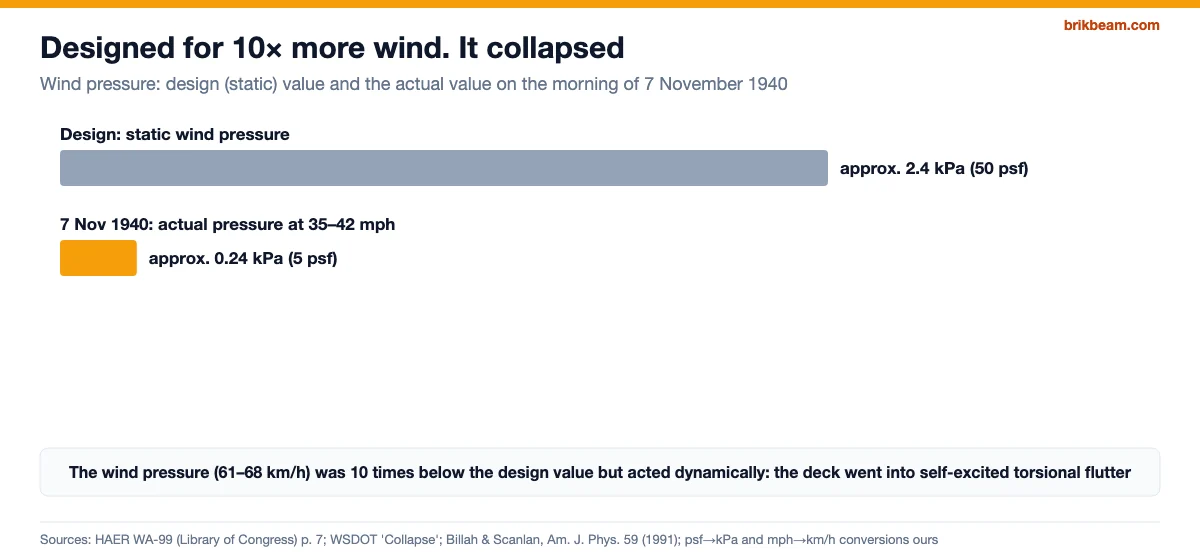
The bridge was designed for a static pressure of 2.4 kPa; that morning the pressure was only about 0.24 kPa, ten times less. The key word, though, is "static": the wind acted dynamically (HAER WA-99).
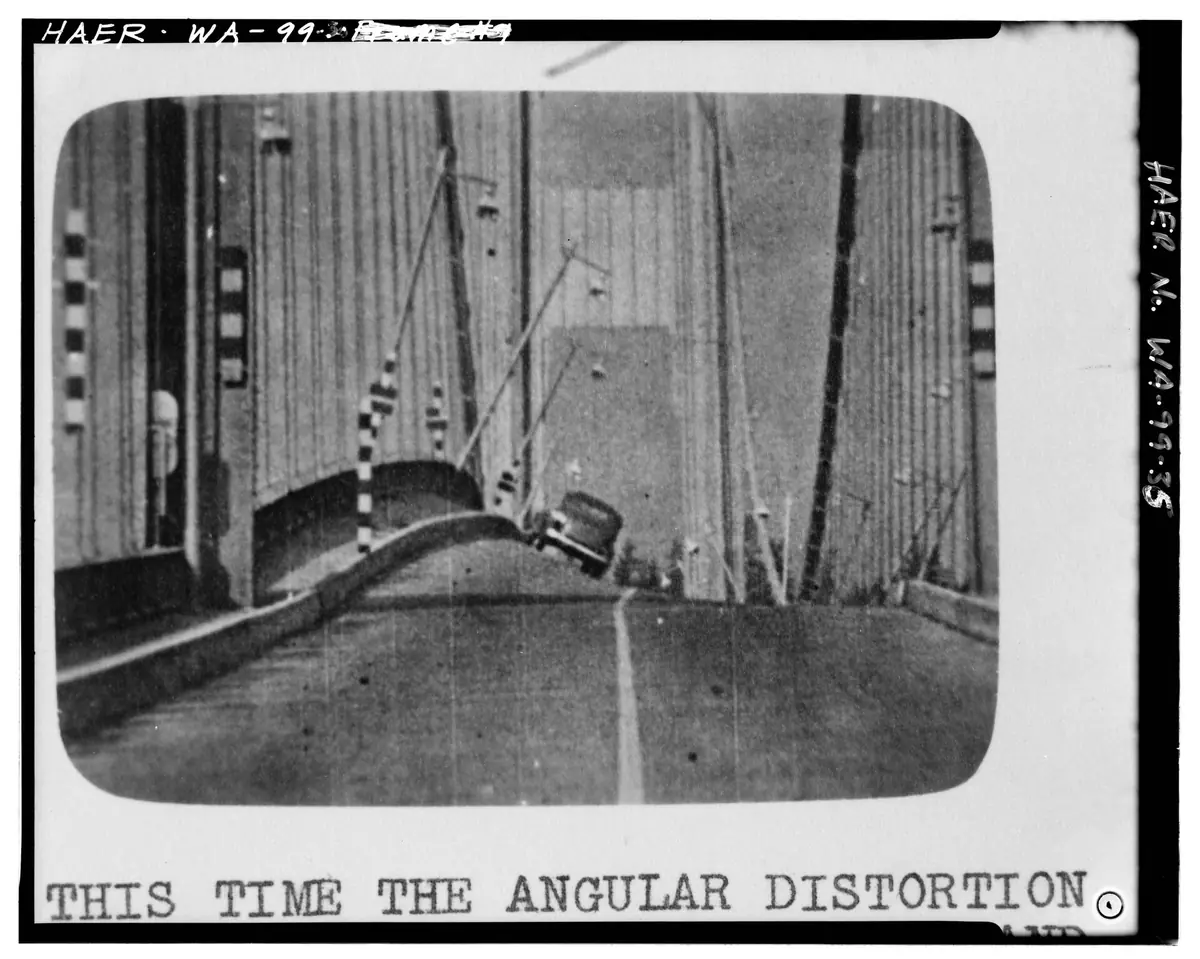
Before 10 a.m. the deck moved vertically: Farquharson counted 9 waves at 38 cycles per minute. A few minutes after 10 the motion suddenly turned into twisting about the centreline of the roadway: the frequency dropped to 12 cycles per minute (0.2 Hz), the deck tilted up to 45°, and the edges of the roadway moved 8.5 m apart (WSDOT; Billah & Scanlan). At about that time a cable band slipped on the north cable at mid-span; the cable later had more than 350 broken wires at that point. WSDOT links this to the switch to twisting, but sources differ on the order of events.
Leonard Coatsworth, an editor at the Tacoma News Tribune, abandoned his car on the bridge with his daughter's dog, Tubby, inside and crawled to safety. Farquharson tried to rescue the dog, but the terrified animal bit him. At about 11:02 the first section of roadway (about 183 m) fell, and by about 11:10 almost the whole centre span was in the water (WSDOT; HAER; Physics Today). The state later paid Coatsworth USD 450 for the car and USD 364.40 for its contents, including the dog (WSDOT).
Resonance or flutter? Let's do the maths

The textbook explanation speaks of forced resonance: the wind supposedly pushed the bridge in time with its natural frequency, like a swing. The numbers do not fit. Billah and Scanlan (1991) calculated that at 42 mph Kármán vortices would shed from the deck at about 1 Hz, while the destructive motion was 0.2 Hz. The vortices were "beating" about five times faster than the bridge was moving.
The cause was self-excited torsional flutter: the motion of the deck itself lined the wind forces up in phase with the motion, so each twist drew a little more energy from the wind. The difference matters in practice: resonance works in a narrow frequency band, whereas flutter only gets worse once the wind passes a threshold speed. According to Farquharson's 1:50 model, the flutter threshold for the real bridge corresponded to about 26 km/h (16 mph), so 68 km/h was far above it (Billah & Scanlan). Engineers still argue over details, such as the role of vortices at an earlier stage (HAER; WSDOT).
The film myth: Barney Elliott filmed the twisting at 16 frames per second, but the transfer to video assumed 24. That is why the popular clip shows the bridge twisting 18 times a minute instead of the 12 measured with a stopwatch, about 50% too fast (Olson, Wolf, Hook, Physics Today, 2015). The collapse itself, filmed with a different camera, runs at the correct speed.
The inquiry, the blame and the replacement
A Federal Works Agency board (Othmar Ammann, Theodore von Kármán, Glenn B. Woodruff) reported in March 1941 that the main cause was excessive flexibility, that the solid girder and deck acted like an aerofoil, and that aerodynamic forces were poorly understood. Suspension bridges would from then on have to be tested on models in wind tunnels. The board named no culprit; Moisseiff was cleared (WSDOT; ASCE).
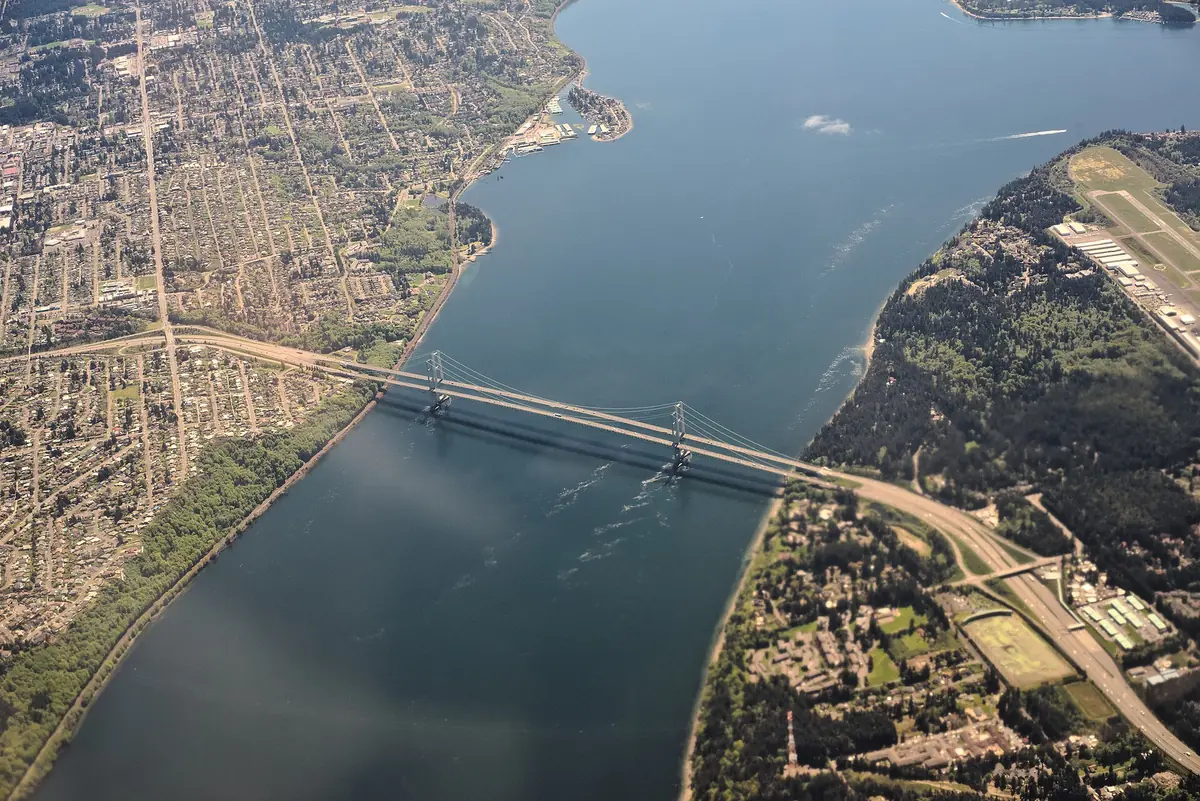
The new bridge opened on 14 Oct 1950 on the same piers. Instead of a solid girder it has a 10 m (33 ft) deep Warren truss, open grating slots in the roadway and hydraulic dampers. According to WSDOT it is 58 times stiffer than the 1940 bridge, and it cost about USD 14 million (WSDOT). A third bridge opened alongside in 2007, at USD 849 million (WSDOT; HistoryLink). The wreckage of the 1940 bridge lies on the bottom of the strait and has been on the US National Register of Historic Places since 1992 (WSDOT).
| 1940 bridge | 1950 bridge | Sources | |
|---|---|---|---|
| Stiffening | solid girder 2.44 m | Warren truss 10 m | WSDOT |
| Stiffness | 1× | about 58× | WSDOT |
| Cost | USD 6.4 m | about USD 14 m | WSDOT |
| Lasted | about 4 months | still standing | WSDOT; HistoryLink |

What builders and investors can take from it
- The cheaper design is not always cheaper. Saving USD 4 million on a lighter structure ended with the loss of the whole bridge after four months and a decade without a fixed crossing.
- Stiffness is a safety parameter too. The 1950 bridge is 58 times stiffer. A house works the same way: a rafter or beam that is too slender may carry the load yet still deflect and vibrate too much. Check rafter sizes in the roof framing calculator and snow loads in the snow load calculator.
- Statics is not everything. A wind ten times below the design pressure destroyed the bridge because it acted dynamically. For light, slender structures (canopies, masts, footbridges), ask the designer about vibration, not only load capacity.
The episode and Shorts
The full episode is embedded above (Polish audio). Shorts (Polish): That famous Tacoma film runs 50% too fast, One fatality, and it was not a person, A bridge USD 4 million cheaper. It fell after 4 months, Designed for 10× the wind. It collapsed, On this bridge cars disappeared behind a wave.
Other episodes with articles: Megaprojects: all BrikBeam episodes. The bridge where it all began: the Golden Gate by the numbers.
▶ Subscribe to BrikBeam on YouTube: megaprojects worked out so you can check the maths.
Sources
- WSDOT, Tacoma Narrows Bridge history: "1940 Narrows Bridge – The Machine", "Collapse", "Eyewitness accounts", "Aftermath", "Lessons from failure", "Weird facts" (web.archive.org copies, 2024).
- HAER WA-99, Tacoma Narrows Bridge, Library of Congress (documentation and film frames).
- K. Y. Billah, R. H. Scanlan, "Resonance, Tacoma Narrows bridge failure, and undergraduate physics textbooks", American Journal of Physics 59(2), 1991.
- D. Olson, S. Wolf, J. Hook, "The Tacoma Narrows Bridge collapse", Physics Today 68(11), 2015.
- ASCE, "Tacoma Narrows Bridge" (Historic Civil Engineering Landmark).
- University of Washington, Special Collections (film and bridge data).
- HistoryLink, essay 7113 (the 2007 bridge).
By the BrikBeam editorial team, 22 Nov 2026. US unit conversions are ours. Spotted a mistake? Tell us via the contact form.
Pobierz kompletny pakiet wzorów umów i protokołów budowlanych
Zyskaj natychmiastowy dostęp do prawnie sprawdzonych szablonów: Umowa o roboty budowlane, Umowa z podwykonawcą, Plan BIOZ, Protokół odbioru końcowego, Karta gwarancyjna i Harmonogram. Gotowe do edycji w Word i Excel.